
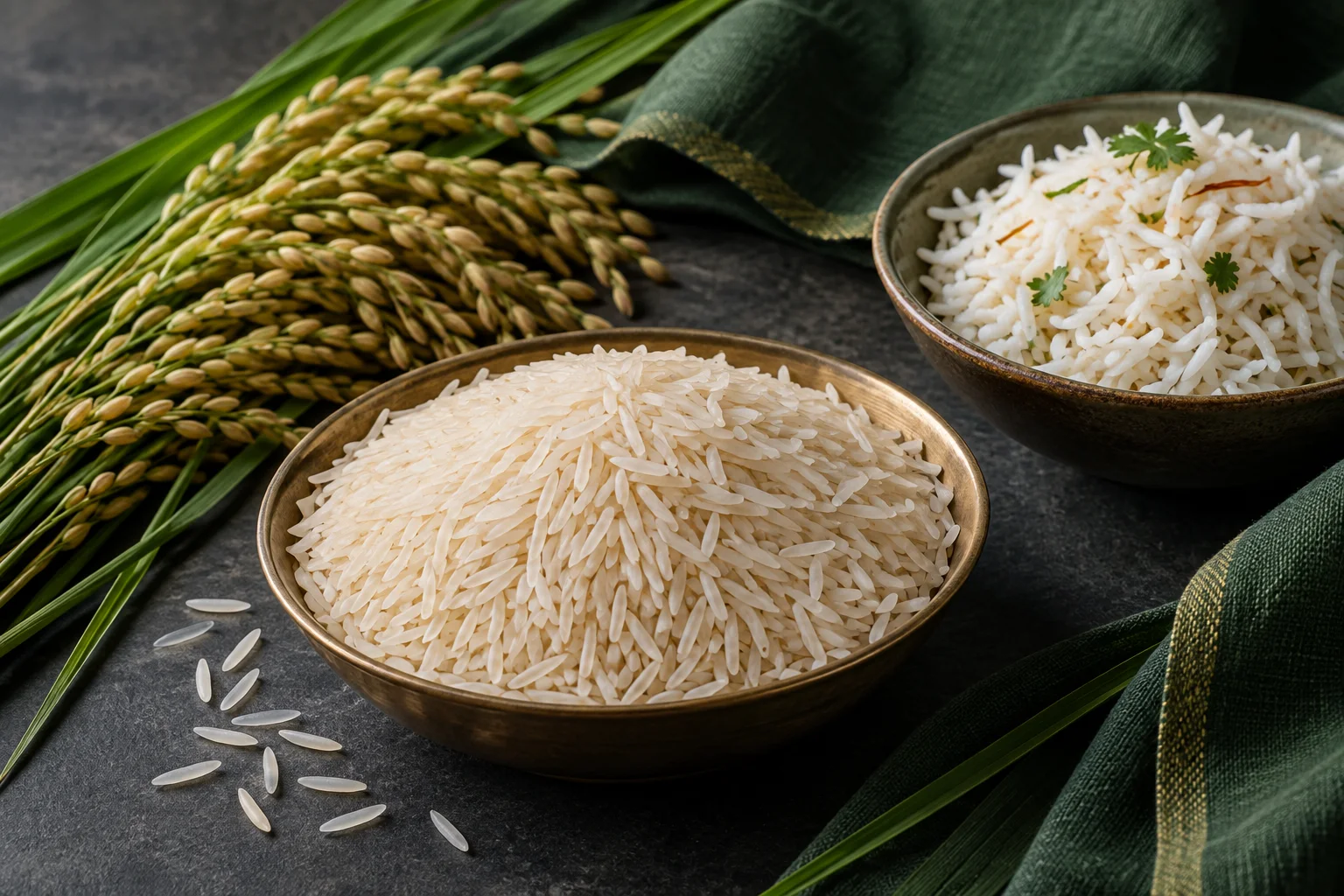
Pusa 1718 Basmati Rice: Grain, Cooking and Buying Guide
A clear guide to Pusa 1718 Basmati rice, including its background, grain profile, cooking performance and bulk buying checks.
Pusa Basmati 1718 is an extra-long variety connected closely to the famous 1121 line. It is important to farmers because it was developed with resistance to bacterial blight, and important to buyers because it can deliver the premium appearance expected from modern Basmati.
A variety name, however, does not guarantee one fixed result. Crop year, field conditions, milling, processing, ageing and grading still shape every commercial lot.
Quick answer
1718 is a strong premium Basmati option for buyers seeking extra-long, slender grains, aroma and attractive elongation. Approve it by specification and cooking test.
Key points at a glance
- Derived from the Pusa 1121 background.
- Known for extra-long slender grain and strong cooked length.
- Available in multiple processing forms.
- Lot approval remains essential.
What makes 1718 notable
ICAR describes Pusa Basmati 1718 as a marker-assisted, bacterial-blight-resistant version derived from 1121. This agricultural improvement supports production; it does not remove the need for commercial quality control.
Buyers should separate agronomic traits from the eating and cooking traits listed in their contract.
Raw, Steam or Sella 1718
Raw 1718 can suit buyers who prefer a lighter appearance and softer bite. Steam processing supports separation. Sella and Golden Sella add firmness and tolerance for high-volume kitchens.
Choose the form before asking for quotes, then compare suppliers like for like.
How to cook a test sample
Rinse equal weights, soak for the same period and use controlled water, heat and resting time. Measure raw and cooked length across several grains. Note aroma, texture, separation and any breakage.
Follow our blind sample testing method to keep the decision objective.
What bulk buyers should document
Include varietal purity, grain-length method, broken tolerance, moisture, damaged grains, foreign matter, crop year, ageing, packing and destination residue limits. Ask how the supplier maintains traceability.
The approved sample should be sealed and identifiable throughout shipment preparation.
A simple decision checklist
- Confirm notified variety and processing form.
- Review representative raw sample.
- Run a controlled cook test.
- Check COA and residue plan.
- Approve packing and loading conditions.
Frequently asked questions
Is 1718 the same as 1121?
It is derived from 1121 but is a separately notified variety.
Can restaurants use 1718 for biryani?
Yes, when the selected form and lot deliver the required separation and holding quality.
Does 1718 need ageing?
Ageing can improve cooking behaviour, but the useful period depends on storage and the target result.
Final takeaway
1718 belongs in a premium buyer’s shortlist, but its real value appears only when the exact lot satisfies a measurable specification and repeatable cooking test.
For a quotation, sample or specification discussion, review Surya Foods products, our quality-control process, and global export support, then contact our team.