
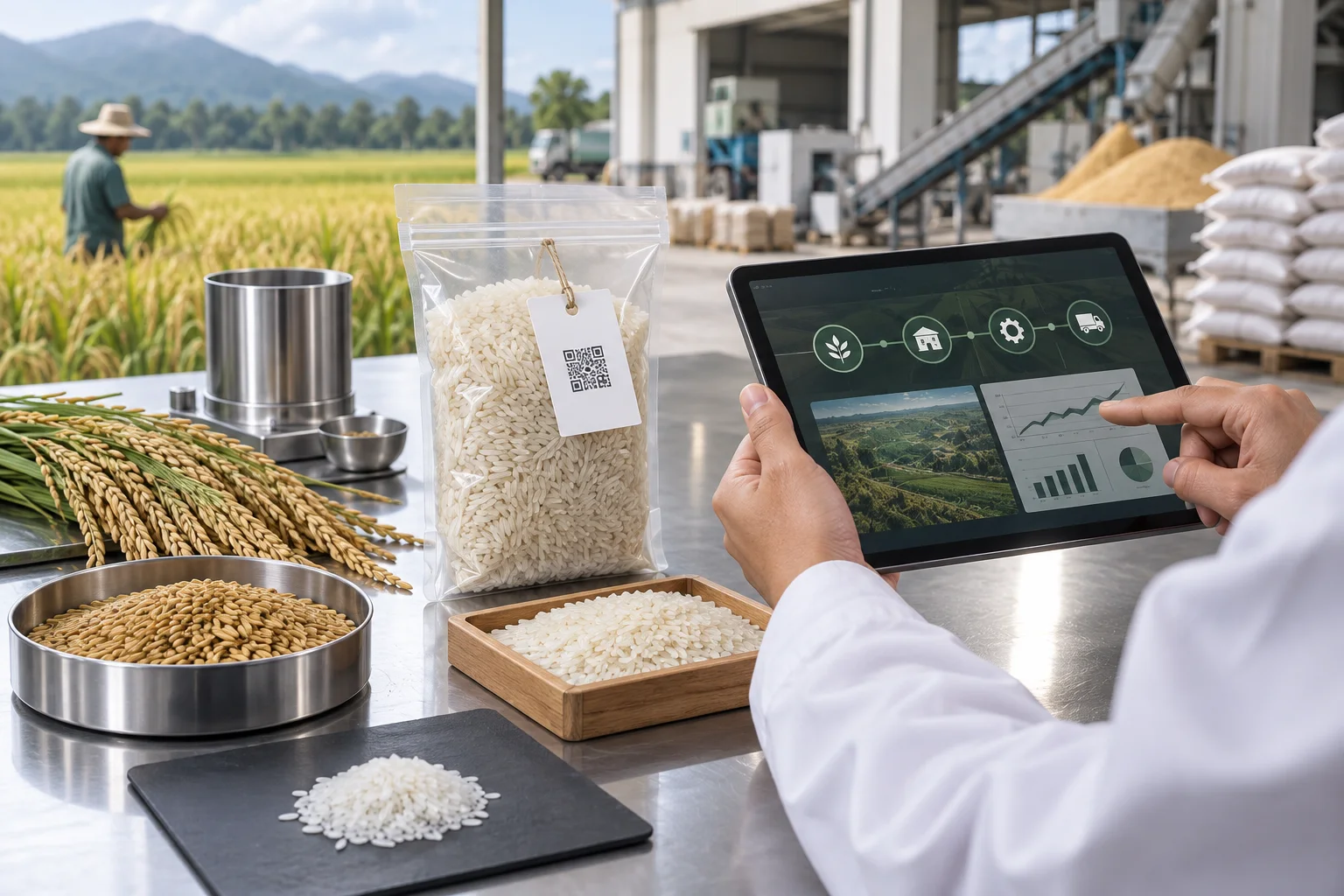
Basmati Rice Traceability: From Farm and Paddy to Export Bag
Learn how Basmati traceability connects farmers, paddy lots, milling, tests, packing and shipments for stronger quality control.
Traceability answers a simple question: where did this bag come from, and what happened to the rice before it reached the buyer? A reliable system links records instead of storing unrelated certificates.
For Basmati, traceability also supports authenticity, residue management and faster investigation when a complaint occurs.
Quick answer
Assign clear identities to farms or paddy sources, intake lots, processing batches, laboratory samples, packing runs and shipment units, then preserve the links between them.
Key points at a glance
- One lot code should lead backward and forward.
- Mass balance helps detect impossible records.
- Samples and reports need the same identity.
- Mock recalls test whether the system works.
Farm and paddy records
Record grower or source, location, notified variety, crop year, agricultural inputs and harvest. At mill intake, connect weight, date, vehicle, quality checks and storage bin to a unique paddy lot.
Processing records
Cleaning, parboiling, drying, milling, grading and sorting can combine or divide material. Batch records should show every movement and rework. Mass balance compares input, output and normal loss.
Testing and packing
Laboratory sample IDs should point to the production lot. Packing records connect finished product to bag material, line, date and quantity. This makes a COA useful beyond the page itself.
Shipment and recall readiness
Container, seal, invoice and packing list should connect back to finished lots. APEDA’s Basmati.Net provides a sector traceability platform for the Basmati value chain. Businesses should also test their internal system with mock trace exercises.
A simple decision checklist
- Use unique lot codes.
- Link every transformation.
- Reconcile quantities.
- Attach tests to lots.
- Run backward and forward trace tests.
Frequently asked questions
Is a QR code traceability?
It is only an access tool; the underlying records and links create traceability.
What is mass balance?
It checks whether recorded outputs and losses reasonably match inputs.
Why trace forward?
Forward trace shows every customer or shipment that received an affected lot.
Final takeaway
Good traceability is a connected evidence chain. It improves daily control and shortens the path from a problem to a precise response.
For a quotation, sample or specification discussion, review Surya Foods products, our quality-control process, and global export support, then contact our team.