
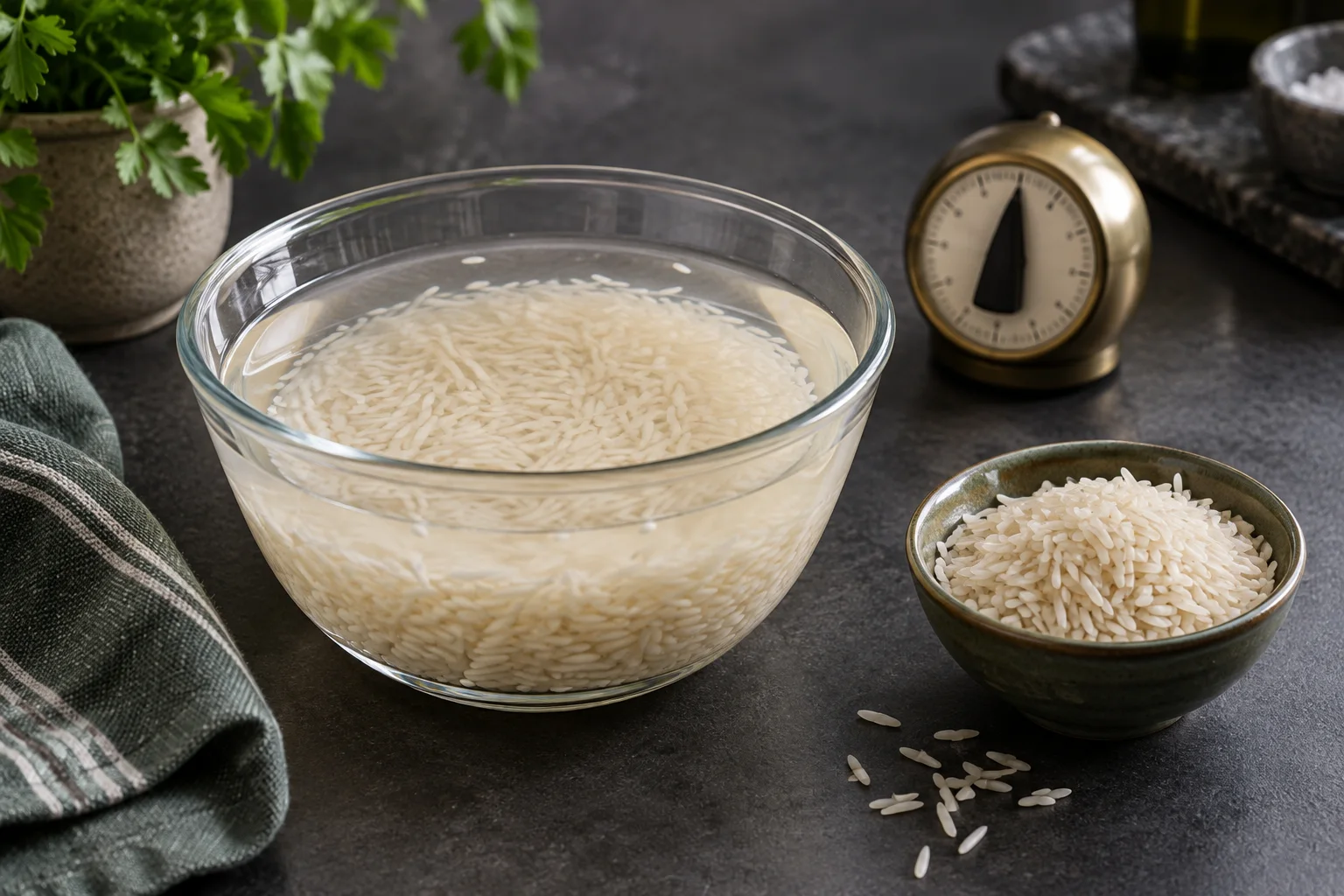
Should You Soak Basmati Rice? Timing and Benefits Explained
Learn why Basmati rice is soaked, how long to soak different forms and how soaking affects cooking time, length and texture.
Soaking gives water time to enter a Basmati grain before strong heat reaches it. That can support even cooking and help a long grain expand with less breakage.
It is useful, but not automatic. New-crop Raw rice and aged Sella rice may need different times.
Quick answer
Soak most white Basmati for 20 to 30 minutes as a starting point. Shorten the time for soft new crop; extend carefully for firm Sella. Always drain before measuring cooking water.
Key points at a glance
- Rinse before soaking.
- Use clean room-temperature water.
- Drain thoroughly.
- Do not copy one time for every rice.
What soaking changes
Water begins moving into the dry kernel. This reduces the distance moisture must travel during cooking and can support a more even centre. Gentle handling after soaking matters because hydrated grains are easier to damage.
A practical timing guide
For everyday Raw or Steam Basmati, 20 to 30 minutes is a useful first test. Very fresh rice may need less. Firm parboiled rice may need longer. If the grain breaks easily after soaking, shorten the time or handle it more gently.
Adjust cooking water
Soaked rice carries water into the pot, so an unsoaked ratio may produce softness. Drain in a sieve for several minutes and use the water-ratio method. Keep notes on both soaking and cooking water.
When you can skip soaking
A quick household meal can be made without soaking if water and time are adjusted. Some rice cookers also handle unsoaked rice well. The trade-off may be slightly less even elongation or a longer cook. Your test result should decide.
A simple decision checklist
- Rinse without rough rubbing.
- Time the soak.
- Drain fully.
- Reduce cooking water if needed.
- Rest and fluff gently.
Frequently asked questions
Can Basmati soak overnight?
Usually that is unnecessary and may make some samples fragile or too soft.
Do I soak rice for biryani?
Most biryani methods benefit from soaking because rice is par-cooked and layered.
Should water be hot?
Room-temperature water gives an easy, controlled starting point.
Final takeaway
Soaking is a tool, not a rule carved in stone. Match the time to the rice, drain well and measure the final result.
For a quotation, sample or specification discussion, review Surya Foods products, our quality-control process, and global export support, then contact our team.