
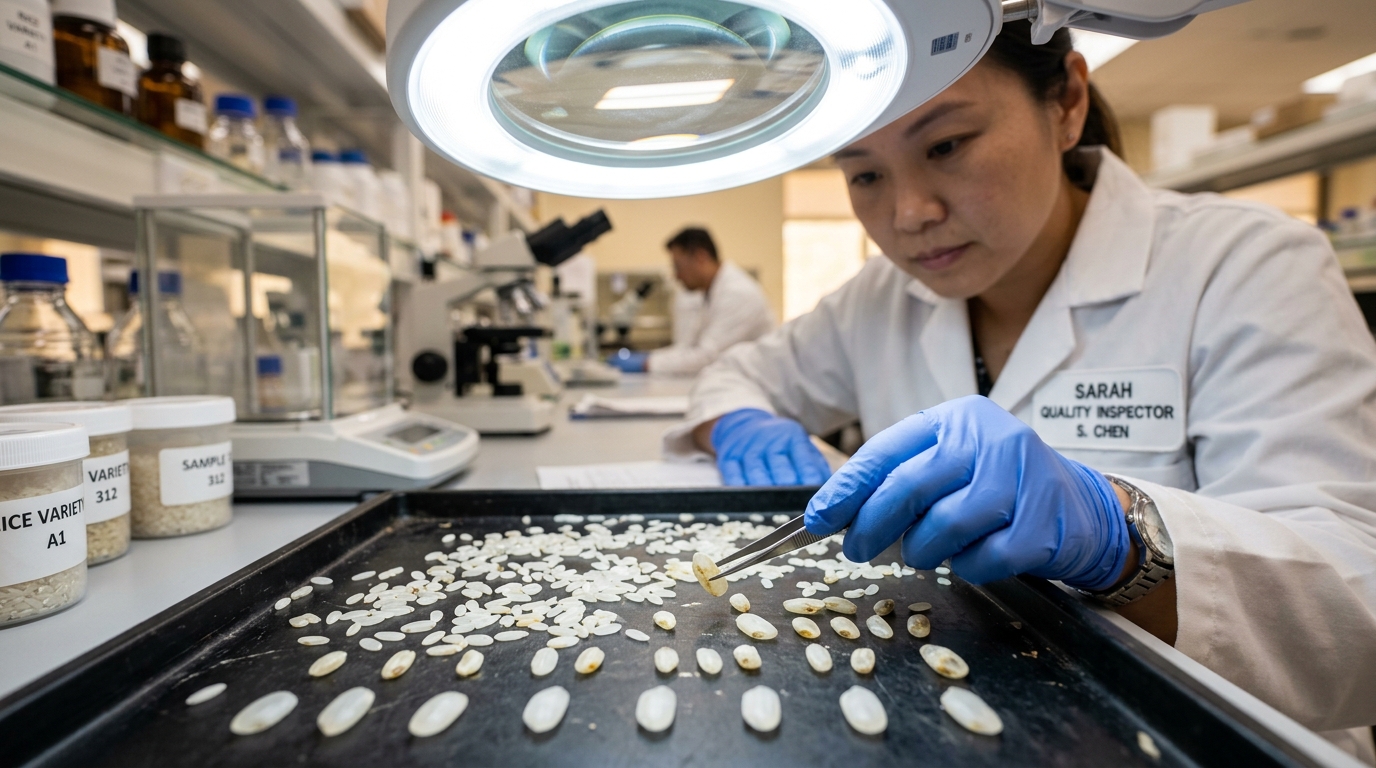
Rice Grain Defects: The Quality Inspector’s View
What looks like a tiny discoloration or crack in a single rice grain can become a major quality issue across a 25-ton shipment. Here’s how inspectors identify rice defects.
What looks like a tiny discoloration or crack in a single rice grain can become a major quality issue across a 25-ton shipment. Here’s how millers, exporters, importers, and quality inspectors identify rice defects before the product reaches the customer.
Introduction: A Buyer Doesn’t See Just One Grain
Place two samples of rice side by side.
At first glance, they may appear almost identical.
Look closer, however, and a quality inspector may find:
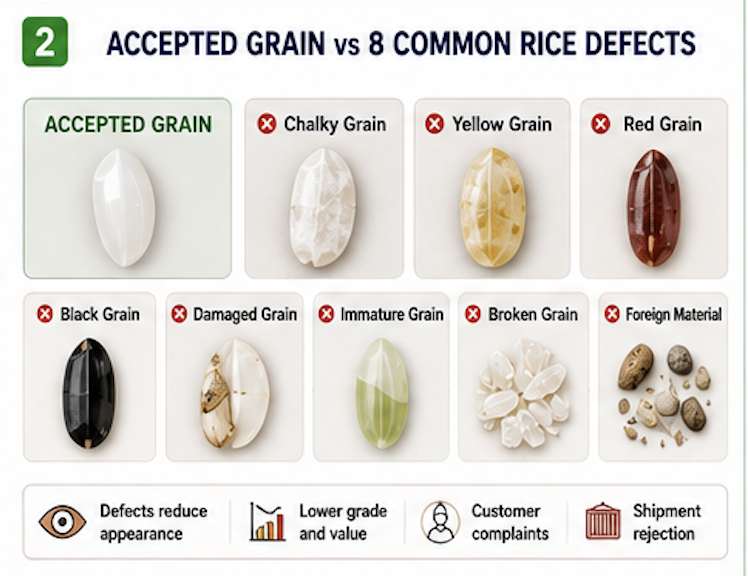
- Chalky grains
- Yellow grains
- Red grains
- Dark or black grains
- Damaged kernels
- Immature grains
- Broken grains
- Foreign material
For a consumer, one defective grain may seem insignificant.
For a rice importer, distributor, wholesaler, retailer, or food manufacturer, the situation is very different.
Small variations multiplied across thousands of bags can affect product appearance, grading, processing performance, customer satisfaction, and ultimately the commercial value of a shipment.
This is why rice quality inspection is an essential part of producing export-quality rice.
Whether Basmati rice is being supplied to the UAE, Saudi Arabia, Qatar, Kuwait, Oman, Iraq, the UK, Canada, or Australia, or non-Basmati varieties are destined for markets such as Malaysia, Singapore, Nigeria, or South Africa, consistency matters.
A quality inspector’s job is therefore not simply to ask:
“Does this rice look good?”
The real question is:
“Does this sample meet the agreed specification?”
What Are Rice Grain Defects?
Rice grain defects are physical, visual, biological, or processing-related abnormalities that cause kernels to differ from the required quality standard.
They can develop at almost any point in the supply chain:
Field → Harvesting → Drying → Storage → Milling → Sorting → Packaging → Transportation
Some defects originate before the paddy reaches the rice mill.
Others are created during processing.
And some develop because of poor storage or handling.
Understanding where a defect comes from is often just as important as identifying the defect itself.
What Does a Good Rice Grain Look Like?
Before identifying defects, inspectors need a reference for acceptable rice.
Depending on the variety and agreed specification, a good milled grain will generally demonstrate desirable characteristics such as:
- Uniform appearance
- Appropriate grain length and shape
- Consistent color
- Proper milling
- Minimal surface damage
- Acceptable translucency
- No visible contamination
For premium Basmati rice, buyers may also pay close attention to characteristics such as grain length, uniformity, aroma, cooking elongation, broken percentage, and overall appearance.
But “good quality” is not universal.
A specification acceptable for one buyer may not be acceptable for another.
That’s why exporters and importers should agree on measurable quality parameters before shipment.
1. Chalky Grains
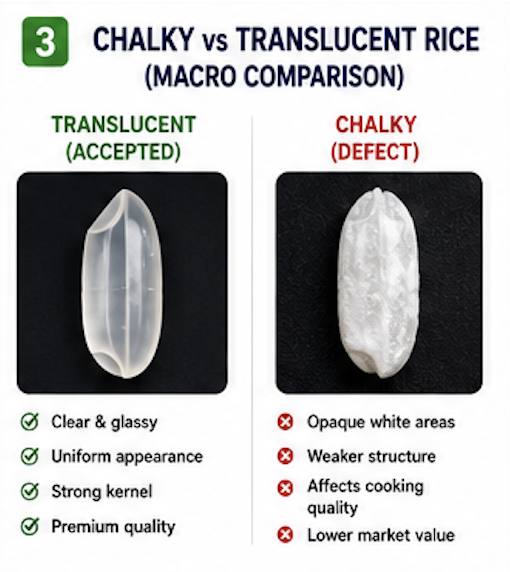
A chalky grain contains an opaque or milky-white portion instead of appearing uniformly translucent.
What does it look like?
The grain may contain:
- White opaque patches
- Milky areas
- Reduced translucency
Depending on severity, only part of the kernel or a large portion of it may appear chalky.
Why does chalkiness matter?
High levels of chalkiness can affect:
- Visual appearance
- Milling performance
- Grain strength
- Perceived quality
- Market grade
Chalky kernels can also be structurally weaker and therefore more susceptible to breakage during milling.
What causes chalkiness?
Chalkiness can be influenced by conditions during grain development, including temperature and other environmental or physiological factors.
For exporters, the important point is simple:
Chalkiness should be identified before packaging—not discovered by the buyer after arrival.
2. Red Grains
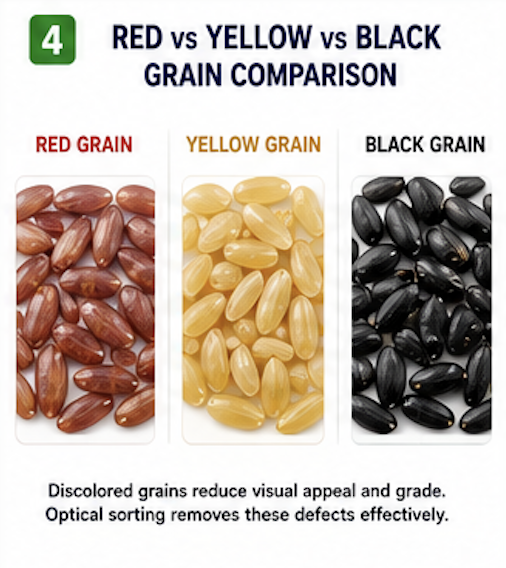
Red grains contain noticeable reddish coloration or red bran layers.
They can stand out immediately when mixed with otherwise uniform white rice.
Why are red grains a problem?
Depending on the product specification, excessive red grains may:
- Reduce visual uniformity
- Affect grade
- Create buyer complaints
- Require additional sorting
Imagine opening a retail pack marketed as premium white rice and seeing visibly red kernels scattered throughout it.
Even when the rice is otherwise usable, the consumer may perceive the entire package as lower quality.
That makes color consistency commercially important.
3. Yellow Grains
Yellow grains display abnormal yellow or yellow-brown discoloration.
They are particularly noticeable in polished white rice.
Why do buyers care?
A few strongly discolored grains can affect the appearance of an entire sample.
For retailers and premium brands, this matters because consumers often judge rice first with their eyes.
Yellow grains may therefore contribute to:
- Visual inconsistency
- Quality downgrading
- Additional sorting requirements
- Buyer claims when limits exceed specification
Where can the problem develop?
Discoloration may be associated with storage and processing conditions, among other factors.
Good storage management and proper inspection are therefore essential.
4. Black or Dark Grains
Dark grains or kernels containing black spots are among the easiest defects to notice in white rice.
A single black grain surrounded by clean white kernels immediately attracts attention.
Potential commercial impact
Excessive dark or black kernels can create:
- Poor visual presentation
- Consumer concern
- Additional sorting costs
- Specification failure
This is exactly the type of defect modern optical sorting equipment is designed to identify efficiently.
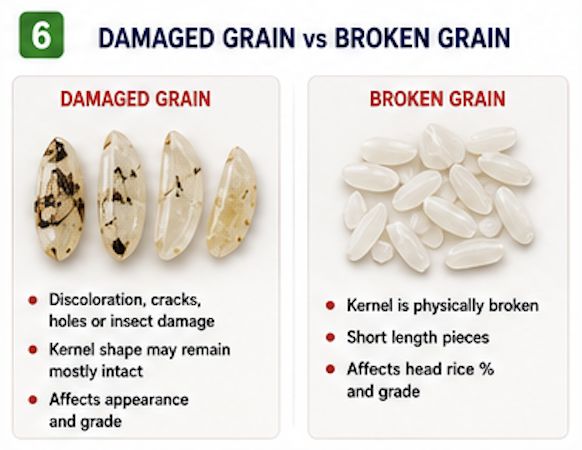
5. Damaged Grains
Not every defective grain is defined by color.
Some grains are physically damaged.
Damage may appear as:
- Cracks
- Chips
- Surface injuries
- Insect damage
- Heat-related damage
- Other physical deterioration
A damaged kernel may remain mostly intact while still failing the required quality standard.
This is an important distinction.
Damaged rice and broken rice are not necessarily the same thing.
6. Immature Grains
Immature grains are kernels that did not fully develop before harvesting.
They may appear:
- Smaller
- Thinner
- Lighter
- Greenish or pale
- Less developed than normal grains
When present in significant quantities, immature grains reduce sample uniformity.
They may also behave differently during milling because underdeveloped kernels can be weaker than mature grains.
Proper paddy selection and pre-cleaning help control this issue before later processing stages.
7. Broken Grains
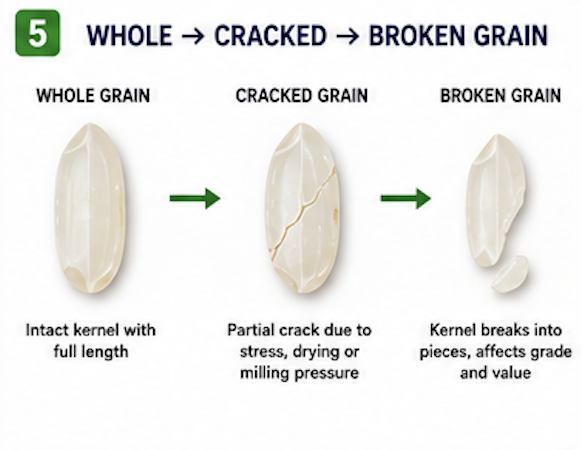
Broken rice is one of the most commercially important quality parameters in the rice trade.
A broken grain is a kernel that has fractured and no longer meets the defined length requirement for a whole kernel under the applicable specification.
Why does rice break?
Breakage can occur because of:
- Moisture variation
- Improper drying
- Internal grain stress
- Rough handling
- Excessive milling pressure
- Mechanical impact
- Poor equipment settings
Broken rice is not automatically unusable or “bad rice.”
It has legitimate markets and applications.
The commercial problem occurs when the broken percentage exceeds what the buyer purchased.
If a contract specifies a particular maximum broken percentage and the delivered shipment exceeds that limit, the buyer may have grounds for a quality claim depending on the contract and inspection results.
This is why controlling broken percentage matters throughout milling and handling.
8. Foreign Material
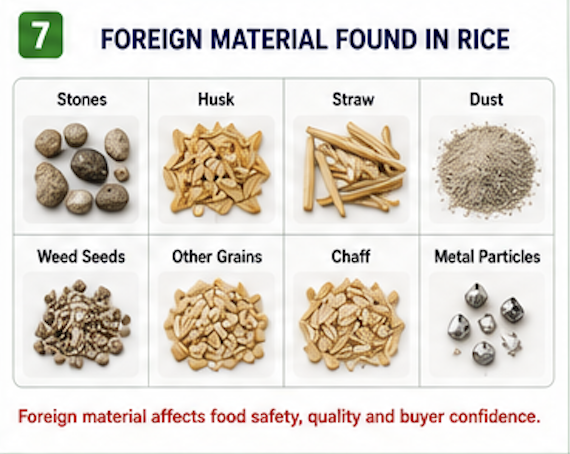
Foreign material is fundamentally different from a natural rice defect.
It refers to unwanted non-rice material present in the product.
Examples may include:
- Stones
- Husk
- Straw
- Dust
- Weed seeds
- Other grains
- Non-rice particles
Foreign material can enter at different stages, particularly during harvesting, transportation, storage, and handling.
Modern rice mills therefore use several layers of protection.
These can include:
Pre-cleaner → Destoner → Magnets → Grading → Optical Sorter → Metal Detection
Each machine solves a different part of the contamination problem.
Optical sorting should not be treated as a replacement for proper cleaning.
It is one component of a complete quality-control system.
Defect or Foreign Material: Why the Difference Matters
Quality inspectors often separate naturally defective rice kernels from foreign material because they represent different problems.
| Category | Examples | Main Concern |
|---|---|---|
| Color Defects | Yellow, red, black grains | Appearance & specification |
| Structural Defects | Broken, cracked, damaged | Integrity & grade |
| Development Defects | Immature, chalky grains | Uniformity & quality |
| Foreign Material | Stones, husk, seeds, debris | Purity & food safety |
Understanding these categories makes root-cause investigation easier.
Where Do Rice Defects Actually Come From?
One of the biggest misconceptions is that the rice mill creates every defect.
It doesn’t.
Quality problems can originate throughout the supply chain.
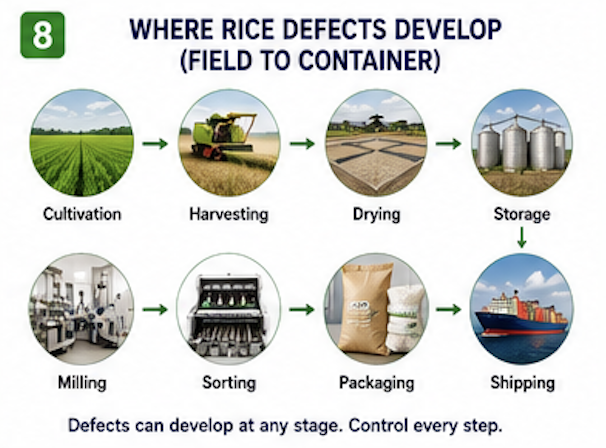
During cultivation
Environmental and crop-development conditions can influence grain characteristics.
During harvesting
Harvest timing and mechanical handling can influence kernel condition.
During drying
Improper or uneven drying can create internal stresses that make grains more vulnerable to cracking.
During storage
Poor moisture and temperature management can contribute to deterioration, discoloration, pests, and other quality problems.
During milling
Excessive pressure, friction, or incorrect machine settings can increase breakage.
During handling
Repeated drops and mechanical impacts can damage kernels.
During packaging and shipping
Poor packaging, container conditions, or moisture exposure can compromise an otherwise good product.
This is why rice quality control must cover the entire supply chain.
How Quality Inspectors Evaluate a Rice Sample
Professional inspection is not simply someone looking at a handful of rice and deciding whether it looks acceptable.
A representative sample is evaluated against defined parameters and the agreed specification.
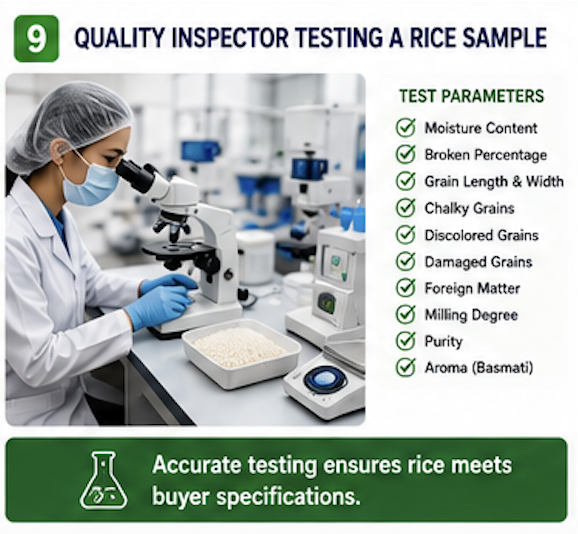
Depending on the rice and contract, inspection may include measurements of:
- Moisture content
- Broken percentage
- Grain length
- Grain width
- Chalkiness
- Damaged grains
- Discolored grains
- Foreign matter
- Milling degree
- Purity
- Weight
- Aroma where applicable
Laboratory procedures and definitions can vary depending on the buyer, market, standard, and contract.
That is why the agreed specification should always be clear.
The Real-Life Problem: A Sample Can Look Good Until You Look Closely
Consider a distributor purchasing premium rice for a retail brand.
The supplier sends a small pre-shipment sample.
It looks excellent.
The shipment arrives several weeks later.
But when production begins, the distributor notices:
❌ More broken grains than expected ❌ Yellow kernels appearing across packs ❌ Inconsistent grain lengths ❌ Occasional foreign material ❌ Quality varying between bags
Now the issue is no longer just about rice.
The distributor may face:
- Repacking costs
- Additional sorting
- Customer complaints
- Retailer pressure
- Delayed deliveries
- Price negotiations
- Supplier disputes
- Damage to brand reputation
This is why consistency across the shipment matters just as much as producing one attractive sample.
How Optical Sorting Helps Remove Rice Defects
Modern optical sorting has transformed rice quality control.
After cleaning and milling, rice passes through a controlled inspection zone.
High-speed cameras and specialized lighting examine individual grains.
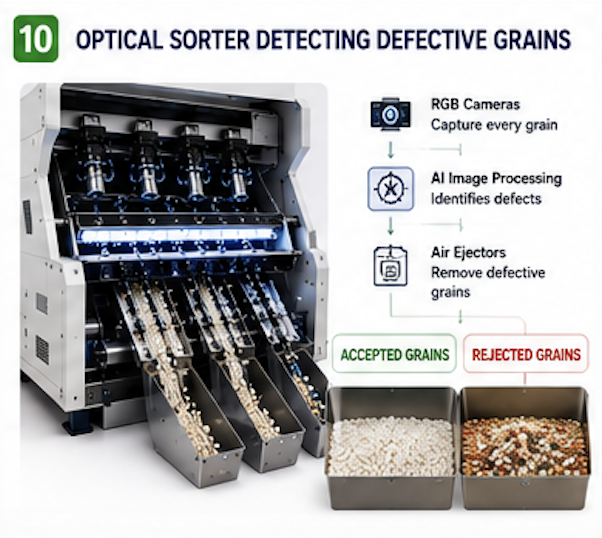
The system analyzes characteristics such as:
- Color
- Shape
- Size
- Surface appearance
When a defective grain or detectable foreign material is identified, precisely timed compressed-air ejectors remove it from the accepted product stream.
This can happen in milliseconds.
Optical sorting is particularly useful for identifying visible differences such as:
- Yellow grains
- Red grains
- Black grains
- Chalky grains
- Some damaged grains
- Certain foreign materials
Advanced systems may also incorporate additional sensor technologies for more complex sorting tasks.
But Technology Alone Doesn’t Guarantee Quality
Buying an expensive optical sorter does not automatically produce export-quality rice.
The final result still depends on:
- Raw paddy quality
- Machine calibration
- Operator experience
- Cleaning efficiency
- Milling settings
- Moisture management
- Maintenance
- Sampling
- Laboratory verification
- Buyer specifications
A poorly configured high-end machine can still produce inconsistent results.
The strongest quality systems combine technology + trained people + defined specifications + verification.
Accepted vs Rejected: The Quality Inspector’s View
Think of inspection as a decision tree.
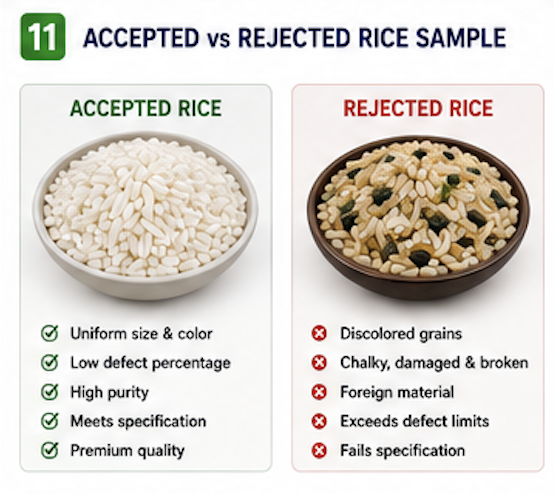
Accepted grain
✓ Correct variety characteristics ✓ Within required dimensions ✓ Acceptable color ✓ Properly milled ✓ Within defect tolerance ✓ Free from unacceptable contamination
Rejected or separated material
✕ Excessive chalkiness ✕ Yellow discoloration ✕ Red grain ✕ Black/dark grain ✕ Physical damage ✕ Immaturity ✕ Broken kernel outside the accepted grade ✕ Foreign material
Importantly, classification depends on the applicable specification.
A kernel rejected from one premium grade may have legitimate use in another product stream.
Why Importers Should Define Specifications Before Ordering
Statements such as:
“We need premium rice.”
are not precise enough for international trade.
“Premium” means different things to different suppliers and buyers.
A professional discussion should establish measurable requirements.
Depending on the product, these may include:
- Rice variety
- Milling type
- Grain length
- Broken percentage
- Moisture limit
- Foreign matter tolerance
- Damaged/discolored grain limits
- Packaging
- Net weight
- Crop year where relevant
- Inspection requirements
Clear specifications protect both sides.
The buyer knows what is being purchased.
The exporter knows exactly what must be produced.
Different Markets, Different Buyer Expectations
A rice shipment does not exist in isolation.
It eventually reaches a particular market and customer.
A distributor supplying premium Basmati to supermarkets in the UAE or Saudi Arabia may prioritize appearance, aroma, grain length, and consistency.
A private-label buyer in the UK, Canada, USA, or Australia may combine product specifications with strict packaging, labeling, traceability, and food-safety requirements.
Buyers in Qatar, Kuwait, Oman, Iraq, Malaysia, Singapore, Nigeria, and South Africa may have different variety, grade, packaging, and price requirements.
The important principle is not that one market always requires “better” rice than another.
It is that:
The correct rice is the rice that consistently meets the agreed customer and regulatory requirements for its destination.
The Cost of Ignoring Small Defects
Suppose a quality problem affects only a small proportion of a shipment.
That percentage may sound insignificant.
But an export container contains thousands of kilograms of product.
A small defect rate multiplied across a commercial shipment can mean a substantial quantity of non-conforming rice.
The consequences may include:
- Rejection
- Discounts
- Claims
- Reprocessing
- Additional inspection
- Customer dissatisfaction
- Lost repeat orders
This is why experienced exporters obsess over details that consumers may barely notice.
Small defects become big problems at container scale.
How Exporters Can Reduce Rice Grain Defects
There is no single machine that solves every quality problem.
Defect reduction requires control throughout production.
1. Start with good paddy
Poor raw material limits what the mill can achieve.
2. Control moisture
Proper moisture management helps reduce cracking and storage-related problems.
3. Optimize drying
Avoid excessive or uneven drying conditions that create stress within the kernel.
4. Maintain milling equipment
Worn or poorly configured machinery can increase breakage.
5. Use proper cleaning and destoning
Remove unwanted material before advanced sorting.
6. Calibrate optical sorters
Sorting parameters should match the variety and buyer specification.
7. Inspect representative samples
Don’t judge an entire lot from one convenient handful.
8. Verify finished product
Final quality checks should occur before packing and shipment.
9. Protect the rice during storage
Maintain suitable storage conditions and pest-control procedures.
10. Inspect before container loading
Quality control should continue until the product leaves the facility.
A Practical Pre-Shipment Quality Checklist
Before rice enters the shipping container, the exporter and quality team should verify the parameters relevant to the contract.
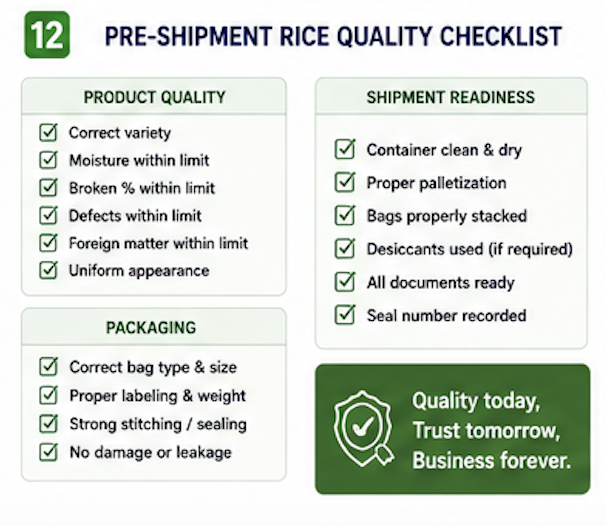
Product
✓ Correct rice variety ✓ Correct milling/process type ✓ Grain dimensions within specification ✓ Broken percentage within agreed limit ✓ Moisture within specification ✓ Defects within agreed tolerances ✓ Foreign material within specification ✓ Overall appearance approved
Packaging
✓ Correct bag type ✓ Correct artwork and labeling ✓ Accurate net weight ✓ Strong stitching/sealing ✓ No damaged bags
Shipment
✓ Container inspected ✓ Container clean and dry ✓ Loading performed correctly ✓ Required documentation completed ✓ Seal number recorded
The exact checklist should always be adapted to the product, destination, buyer contract, and applicable regulations.
Frequently Asked Questions About Rice Grain Defects
Are broken grains considered defective rice?
Broken percentage is an important grading parameter, but broken rice itself is not necessarily waste or unsafe. Broken rice has legitimate food and industrial markets. The issue is whether the percentage meets the grade or buyer specification.
Can optical sorting remove every defect?
No. Optical sorting is extremely powerful, but it should be part of a broader system involving cleaning, destoning, grading, metal detection where applicable, sampling, and laboratory quality control.
What causes chalky rice?
Chalkiness develops during grain formation and can be influenced by environmental and physiological conditions. Chalky kernels contain opaque regions rather than being fully translucent.
Why does rice turn yellow?
Yellowing can be associated with storage and processing conditions. The cause should be investigated because discoloration may indicate deterioration or other quality issues.
Can rice defects develop after milling?
Yes. Poor storage, moisture exposure, pests, packaging failure, or inappropriate transportation conditions can compromise rice after processing.
Why is representative sampling important?
Rice quality may vary within a lot. Inspecting only a small, conveniently selected portion may not accurately represent the entire shipment.
Final Thoughts: Quality Is Measured Grain by Grain
To the consumer, rice may simply be rice.
To the quality inspector, every grain tells a story.
A chalky kernel can reveal grain-development issues.
A broken kernel can point toward drying or milling stress.
A yellow grain may indicate a storage-related problem.
Foreign material can reveal weaknesses in cleaning and process control.
The objective isn’t to claim that every grain will always look identical.
The objective is to control variation, measure quality accurately, and consistently meet the specification promised to the buyer.
For rice exporters, that consistency builds something far more valuable than a visually attractive shipment:
trust.
And in international rice trade, trust is what turns the first container into the second, the tenth, and eventually a long-term business relationship.
At Surya Foods, we leverage state-of-the-art optical sorting technology to ensure every grain meets our rigorous standards. Discover our range of premium sorted Basmati rice on our 048 Brand page or reach out for export inquiries today.