
How Optical Sorting Works: The Technology Behind Cleaner Rice
Discover how AI-powered optical sorting transforms ordinary rice into export-quality rice by removing defective grains with incredible speed and precision.
Introduction
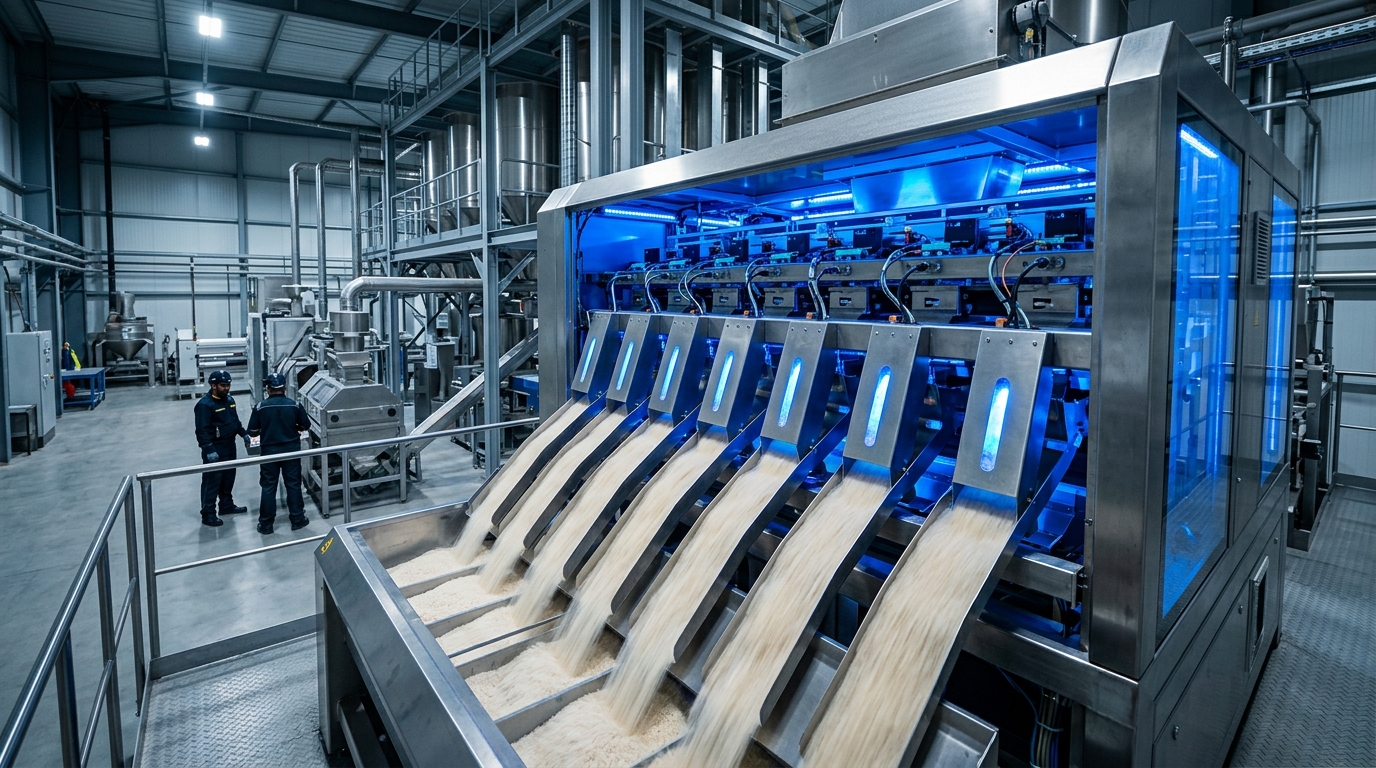
Imagine standing beside a modern rice processing line.
Every second, thousands of rice grains flow through the machine at remarkable speed.
Some grains are perfect.
Others are chalky, yellow, black, broken, immature, or contaminated with foreign material.
To the human eye, identifying every defect would be nearly impossible.
Yet today’s optical sorting machines inspect every single grain in milliseconds, making thousands of decisions every second.
This technology has become one of the most important innovations in the rice industry, helping exporters like Surya Foods deliver consistent quality to buyers in the United Arab Emirates (UAE), Saudi Arabia, Iraq, Qatar, Kuwait, Oman, Malaysia, Singapore, the United Kingdom, Canada, Australia, Germany, South Africa, Nigeria, and many other global markets.
For importers, retailers, and food manufacturers, optical sorting means cleaner rice, greater consistency, and fewer quality claims.
Why Optical Sorting Matters
Modern buyers expect more than attractive packaging.
They expect every shipment to meet agreed quality specifications.
Unfortunately, many rice importers have experienced issues such as:
- Mixed grain colors
- Chalky rice
- Yellow kernels
- Black grains
- Broken rice beyond specification
- Small stones or foreign particles
- Customer complaints after packaging
- Retail rejection due to inconsistent appearance
Even a small percentage of defective grains can reduce the perceived quality of an entire shipment.
For premium Basmati and specialty rice, visual appearance is often one of the first quality indicators buyers evaluate.
Optical sorting helps reduce these risks by identifying and removing defects before the rice reaches the packaging line.
What Is an Optical Rice Sorter?
An optical rice sorter is a high-speed inspection system that uses advanced cameras, specialized lighting, sensors, and intelligent image processing to inspect every grain individually.
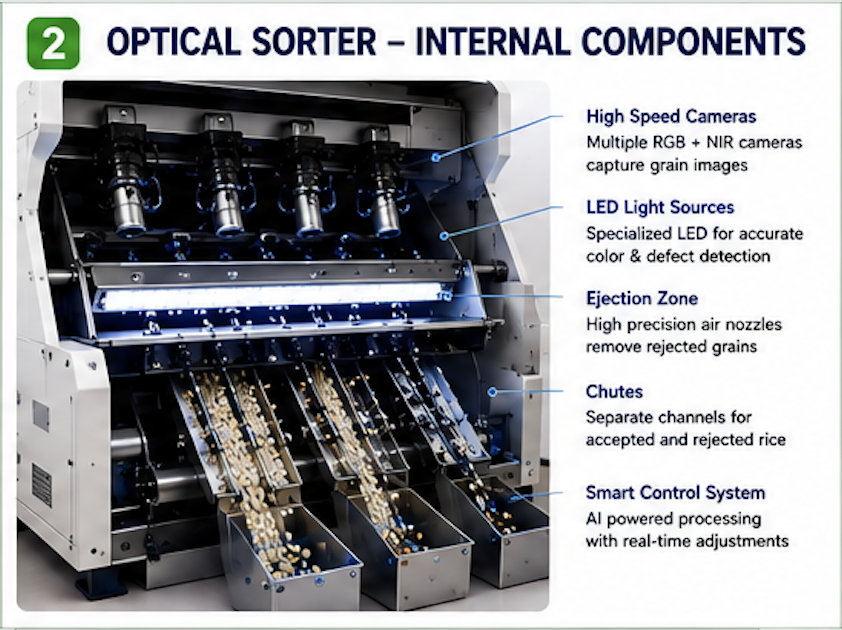
Instead of relying on manual inspection, the machine analyzes each grain in real time and decides whether it should be accepted or rejected.
If a grain does not meet the predefined quality standard, a precisely timed burst of compressed air diverts it into a reject channel while the accepted grains continue toward packaging.
This entire process happens in fractions of a second.
Step 1: Feeding the Rice
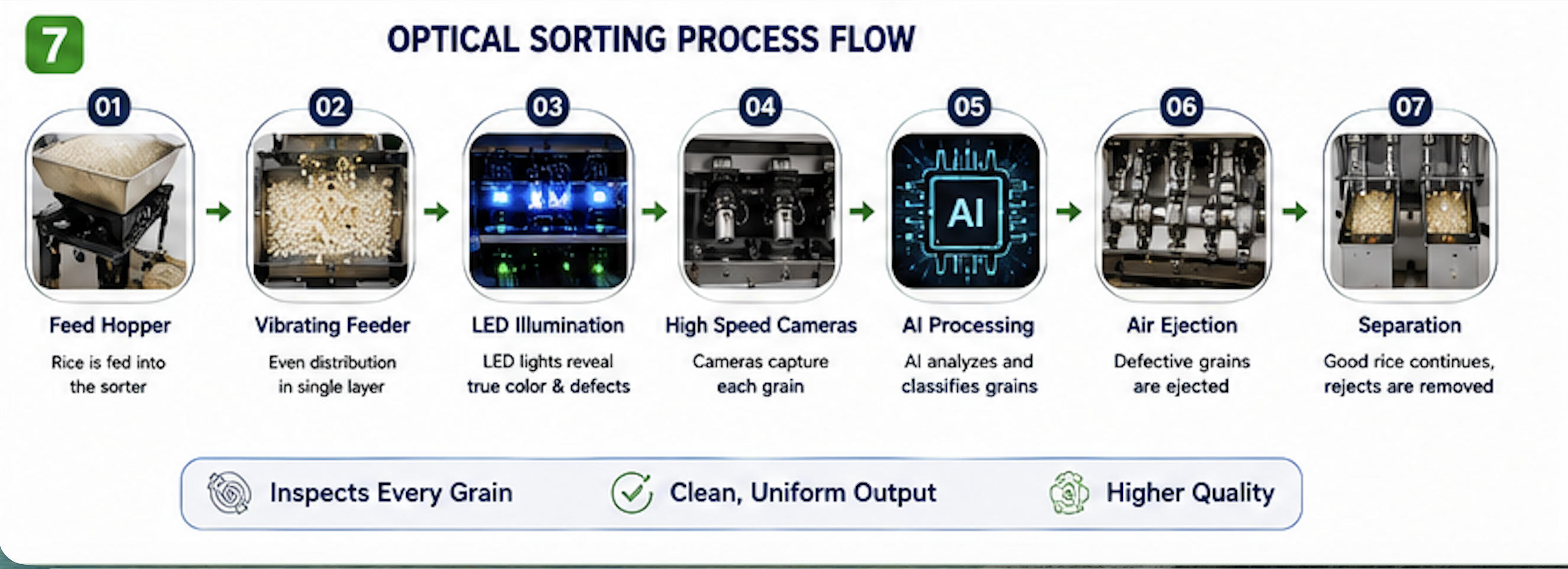
The process begins with a feed hopper.
Rice is introduced into the sorter through a controlled feeding system.
A vibrating feeder spreads the grains into a thin, uniform layer.
This is critical because overlapping grains make accurate inspection difficult.
A single layer ensures every grain is fully visible to the cameras.
Step 2: Gravity Chute Alignment
Once evenly distributed, the grains move down specially designed chutes.
Gravity accelerates the rice while maintaining consistent spacing between grains.
Stable movement improves image accuracy and allows the sorting system to inspect each grain individually without interference.
Step 3: Advanced LED Illumination
Lighting is one of the most important components of optical sorting.
Specialized LED lighting creates a controlled environment where even tiny differences in color, brightness, and surface texture become visible.
Depending on the application, sorters may use:
- White LED lighting
- RGB illumination
- Near-Infrared (NIR) lighting
- Infrared illumination for specific contaminants
Different lighting conditions help reveal defects that may not be visible under ordinary light.
Step 4: High-Speed Cameras Capture Every Grain
As the grains pass through the inspection zone, multiple high-resolution cameras capture detailed images from different angles.
These cameras can inspect thousands of grains every second.
The imaging system evaluates characteristics such as:
- Grain color
- Shape
- Length
- Width
- Surface texture
- Transparency
- Cracks
- Discoloration
Every grain effectively receives its own rapid quality inspection before moving to the next stage.
Step 5: AI-Powered Image Processing
The captured images are instantly analyzed by intelligent software.
Modern optical sorters compare every grain against predefined quality parameters established by the processor.
The system determines whether the grain matches the desired specification.
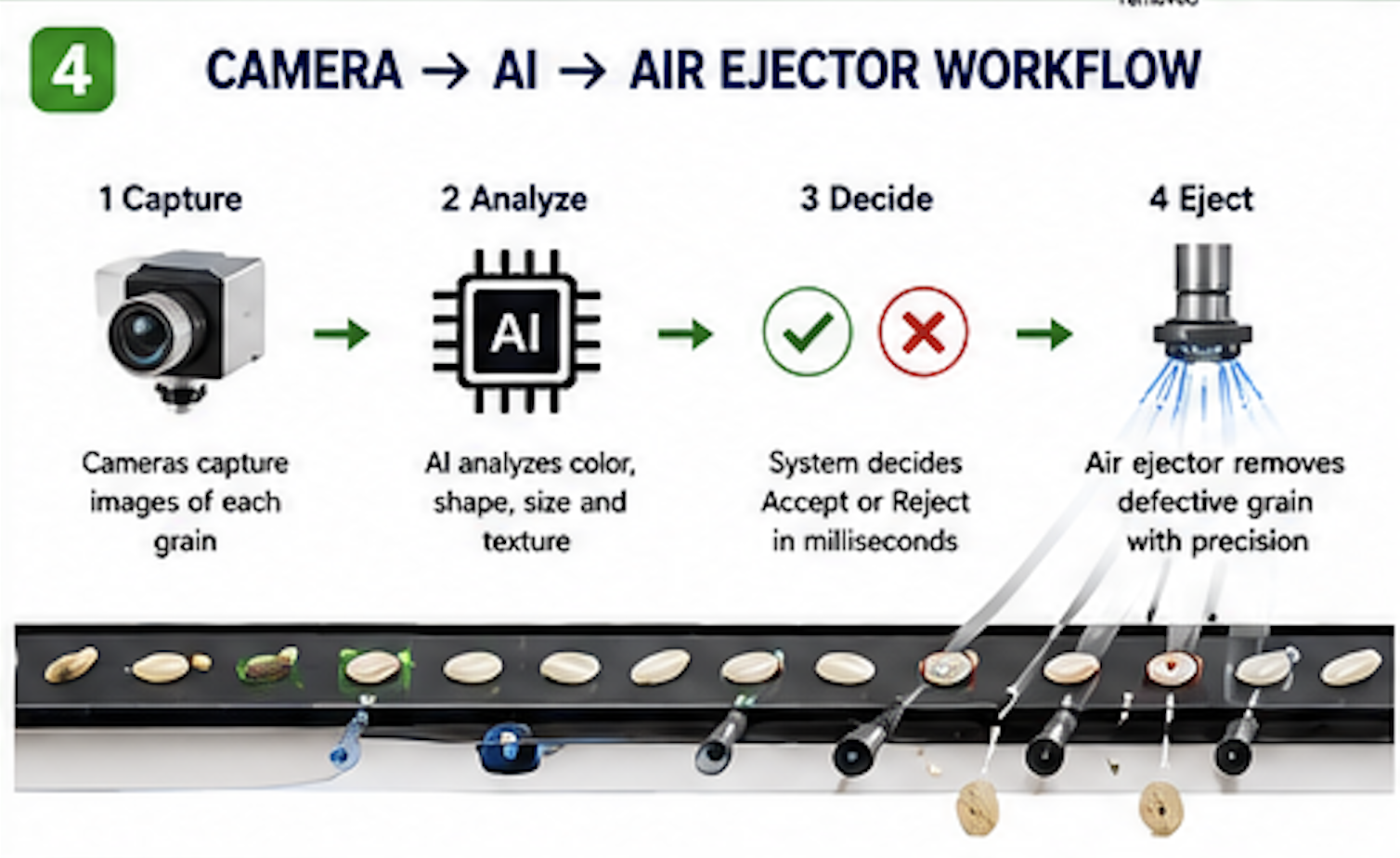
Common defects identified include:
- Chalky grains
- Yellow grains
- Red grains
- Black grains
- Damaged grains
- Broken grains
- Immature grains
- Mold-affected grains
- Foreign material
- Husk fragments
- Stones
- Weed seeds
Advanced systems can distinguish subtle differences that would be difficult to identify consistently during manual inspection.
Step 6: Air Ejection System
This is where the remarkable precision of optical sorting becomes visible.
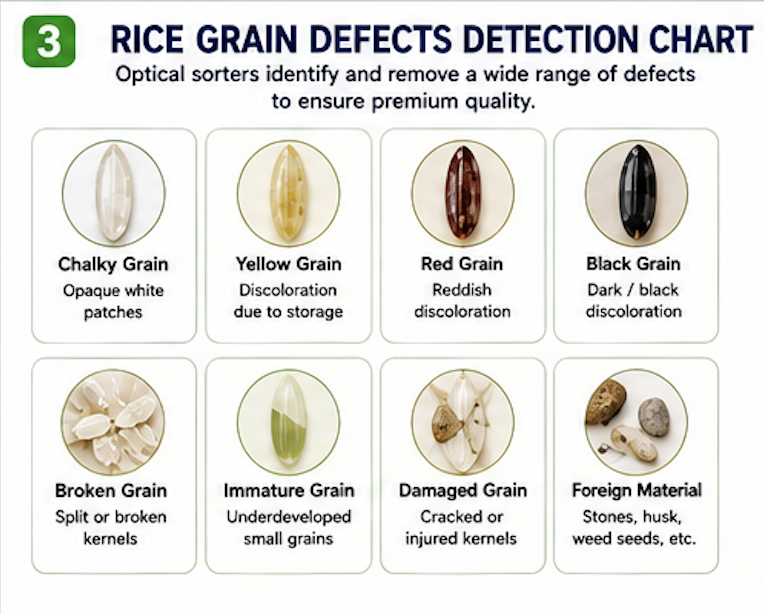
When a defective grain is detected, the system activates a tiny air nozzle positioned directly beneath the inspection area.
A short burst of compressed air removes only the rejected grain.
The surrounding acceptable grains continue along their normal path.
The timing is incredibly precise.
The entire detection-and-ejection sequence occurs within milliseconds.
Step 7: Separation of Good and Defective Rice
After air ejection, two separate product streams are created.
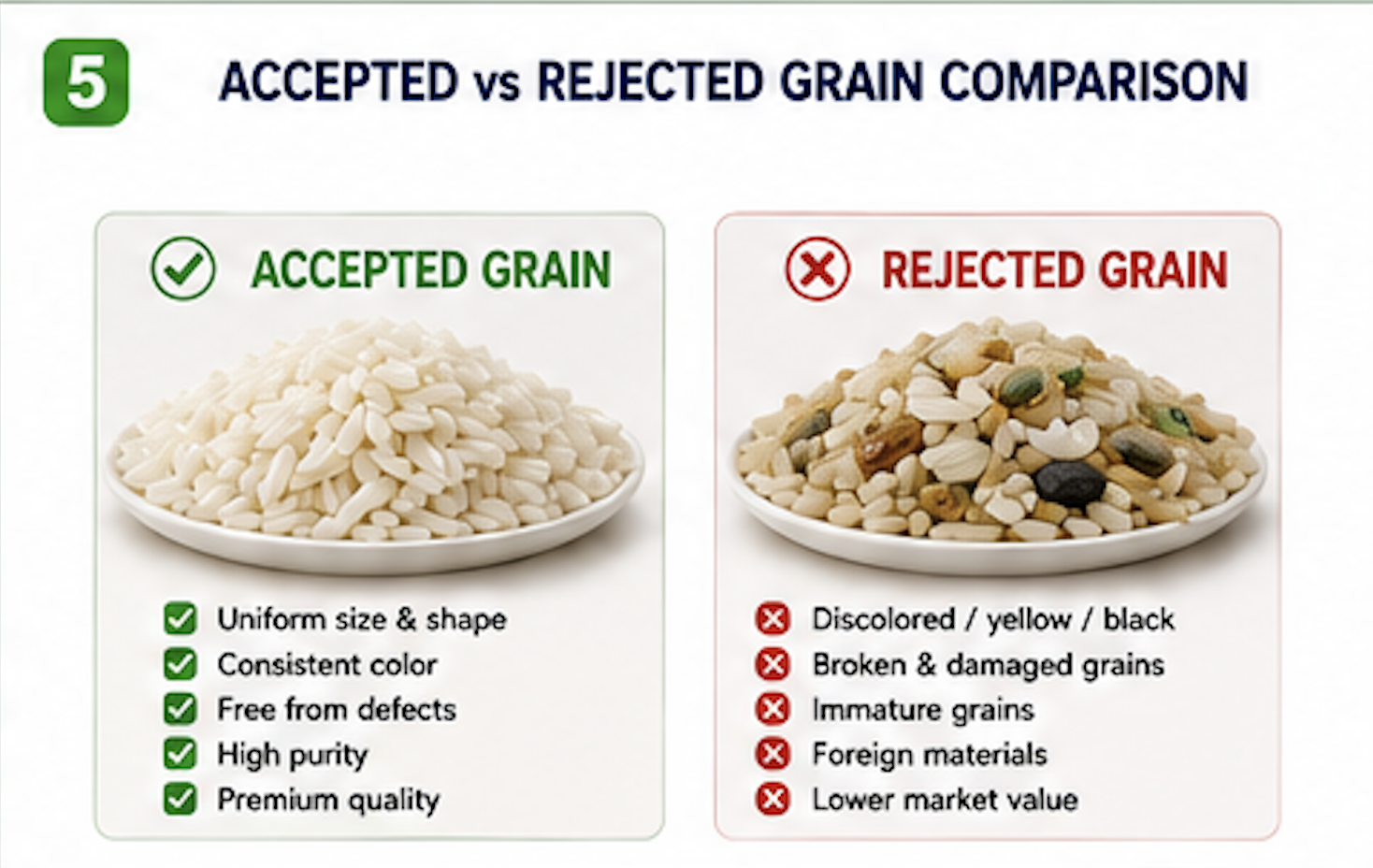
Accepted Rice
The accepted stream contains grains that meet the selected quality specifications.
These grains proceed toward:
- grading
- weighing
- packaging
- palletization
- export
Rejected Rice
The rejected stream contains:
- broken kernels
- discolored grains
- chalky grains
- foreign material
- stones
- husk particles
- damaged rice
Depending on quality and customer requirements, some rejected material may be reprocessed or directed toward other industrial or food applications.
What Defects Can an Optical Sorter Detect?
Modern optical sorters can identify a wide range of quality issues.
Chalky Grains
Opaque white patches that reduce transparency and may affect cooking appearance.
Yellow Grains
Usually caused by storage or environmental factors. Premium export buyers often specify maximum limits for yellow kernels.
Black Grains
Dark discoloration resulting from fungal infection, weather damage, or other factors.
Red Grains
Naturally colored or discolored kernels that can affect visual uniformity.
Broken Grains
Grains fractured during harvesting, drying, or milling.
Immature Grains
Underdeveloped kernels that differ in size, weight, and appearance.
Damaged Grains
Cracked, chipped, insect-damaged, or mechanically injured kernels.
Foreign Material
Examples include stones, husk, straw, dust, weed seeds, and non-rice particles.
Why Buyers Care About Optical Sorting
For international buyers, optical sorting is more than a technical feature. It directly influences business outcomes.
Better sorting helps achieve:
- Higher product consistency
- Improved visual appearance
- Lower defect percentages
- Greater customer satisfaction
- Reduced complaints
- Better shelf presentation
- Improved brand reputation
- Compliance with buyer specifications
For retail brands and food manufacturers, consistency is often as important as price.
Human Inspection vs Optical Sorting
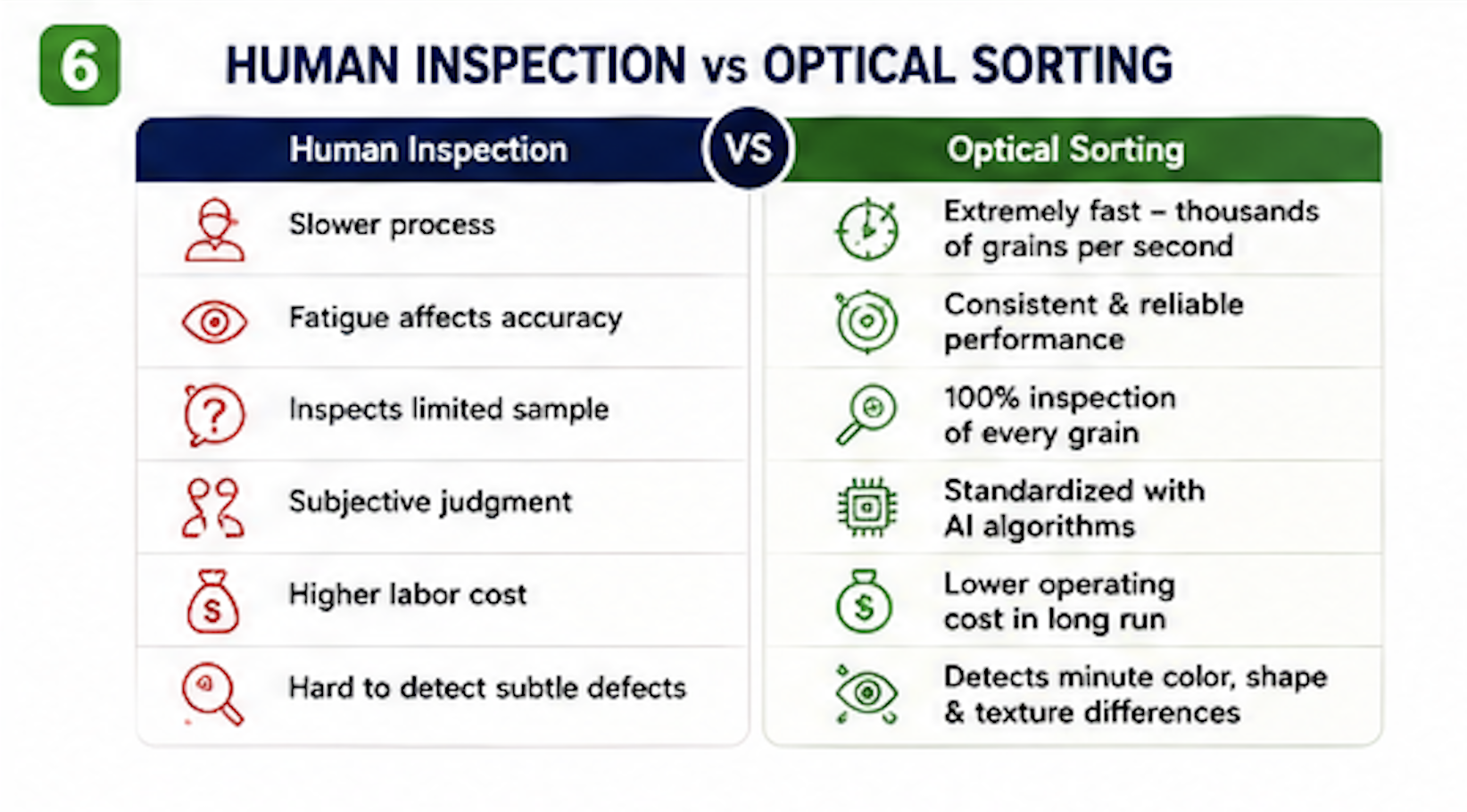
| Human Inspection | Optical Sorting |
|---|---|
| Slower | Extremely fast |
| Fatigue affects accuracy | Consistent performance |
| Limited sampling | Every grain inspected |
| Subjective decisions | Standardized criteria |
| Higher labor requirement | Automated operation |
| Difficult to detect subtle defects | High-resolution imaging and precise detection |
Rather than replacing quality teams, optical sorters allow inspectors to focus on verification, process control, and continuous improvement.
Optical Sorting in the Global Rice Export Industry
Leading rice exporters increasingly use optical sorting to meet the expectations of buyers across international markets.
Whether shipping premium Basmati to Saudi Arabia, UAE, Qatar, and Kuwait, supplying foodservice businesses in the United Kingdom, Canada, and Australia, or exporting non-Basmati rice to Malaysia, Singapore, South Africa, and Nigeria, maintaining consistent quality is essential.

As customer expectations continue to rise, advanced inspection technologies have become a key part of producing export-ready rice.
Frequently Asked Questions
Does optical sorting remove broken rice?
Yes. It can identify and separate broken grains based on size, shape, and configured quality parameters.
Can optical sorters detect stones?
Many modern systems can detect certain stones and foreign materials, particularly when combined with earlier cleaning and destoning equipment. They are most effective as part of a complete processing line.
Does optical sorting improve taste?
Optical sorting does not change the flavor of rice. Its primary role is to improve visual quality, purity, and consistency by removing defective grains and contaminants.
Is optical sorting only used for premium Basmati rice?
No. Optical sorting is widely used for both Basmati and non-Basmati varieties, as well as parboiled and specialty rice, depending on quality requirements.
Final Thoughts
Every export-quality rice shipment reflects thousands of quality decisions made long before it reaches a customer’s warehouse.
Optical sorting is one of the most important of those decisions.
By combining advanced cameras, intelligent image analysis, controlled lighting, and high-speed air ejection, modern sorters inspect every grain with remarkable precision.
The result is cleaner, more consistent rice that helps exporters meet buyer specifications, strengthens customer confidence, and supports long-term business relationships.
In a global market where quality is measured grain by grain, optical sorting is no longer a luxury—it has become an essential part of producing rice that is ready for international trade.
At Surya Foods, we leverage state-of-the-art optical sorting technology to ensure every grain meets our rigorous standards. Discover our range of premium sorted Basmati rice on our 048 Brand page or reach out for export inquiries today.