

From Rice Mill to Shipping Container: The Complete Journey of Export-Quality Rice
Discover how premium Indian Basmati and Non-Basmati rice travels from procurement and precision milling to optical sorting, packaging, and ocean container shipping.
Discover how premium rice travels from Indian mills to dining tables across the world — and why every step in the journey determines quality, consistency, and customer satisfaction.
Introduction
A bag of premium rice sitting on a supermarket shelf in Dubai, Riyadh, Jeddah, Doha, Muscat, London, Toronto, Sydney, Lagos, Johannesburg, or Singapore may look simple.
But behind every grain lies a carefully managed process involving modern milling technology, rigorous quality inspections, moisture control, food safety protocols, export documentation, and global logistics.
For international rice importers, wholesalers, distributors, and retail brands, the biggest concern is rarely the price alone.
The real questions every buyer must answer:
- Will the rice arrive with the same aroma and grain length promised?
- Will moisture remain strictly within specification after 3–6 weeks at sea?
- Will bags arrive intact without condensation, contamination, or shipping damage?
- Will customs documentation, phytosanitary certificates, and lab analyses be 100% compliant?
- Will consumers experience flawless cooking and reorder after the first shipment?
These are the operational standards that separate world-class, reliable export houses from ordinary commodity suppliers.
At every stage — from paddy procurement in the fertile rice belts of India to the exact moment a shipping container is sealed — precision engineering and quality control determine whether an exporter builds decades-long trade partnerships or faces costly rejection claims.
Why Export Quality Begins Long Before Shipping
Many first-time international buyers assume rice quality is determined solely inside the milling plant.
In reality, quality begins months before milling.
Paddy Selection ➔ Moisture Control ➔ Precision Husking ➔ Polishing ➔ Multi-Pass Optical Sorting ➔ Lab Assay ➔ Export Packaging ➔ Containerized Ocean TransitA premier Indian rice exporter focuses on a strict chain of custody:
- Sourcing the right paddy from verified farmer networks and certified mandis
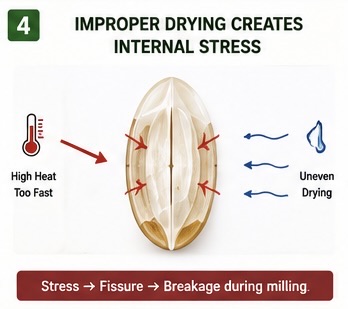
- Controlled mechanical drying to prevent internal kernel stress
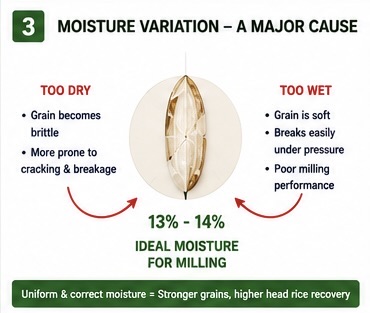
- Consistent moisture management (typically 12.0%–12.5% for international transit)
- Hygienic, climate-controlled storage and aging silos
- Precision multi-stage milling to maximize Head Rice Recovery (HRR)
- High-speed optical color sorting and AI grain profiling
- Batch laboratory assay for physical, chemical, and microbiological purity
- Export-grade multi-layer packaging (BOPP, Non-Woven, PP, Vacuum)
- Moisture-protected container loading and ISO-compliant palletization
International buyers increasingly evaluate suppliers on batch-to-batch consistency, traceability, tamper-evident packaging, and food safety compliance (ISO 22000, FSSAI, APEDA) — far beyond just surface grain appearance.
Step 1: Paddy Procurement & Moisture Testing
Every export-quality shipment starts with carefully selected paddy. Choosing the wrong raw material creates structural defects that no downstream machinery can fix.
Professional grain procurers evaluate raw paddy on five core benchmarks:
- Grain Maturity & Kernel Filling: Ensuring full starch accumulation without premature harvesting.
- Moisture Content at Intake: Testing with calibrated digital moisture meters across truck quadrants.
- Varietal Purity: Verifying genetic authenticity to prevent cross-contamination of grain varieties.
- Foreign Matter & Admixture: Measuring dockage before acceptance at intake hoppers.
- Harvest & Weather Conditions: Tracking rain cycles during ripening to avoid pre-harvest fissure damage.
Major Export Rice Varieties Handled:
- 1121 Basmati Rice (Raw, Steam, White Sella, Golden Sella) — World-renowned for 8.35mm+ raw grain length and extraordinary elongation up to 22mm+.
- 1509 Basmati Rice (Raw, Steam, Sella) — Early-maturing, highly aromatic, and cost-effective premium variety.
- 1718 Basmati Rice (Raw, Steam, Sella) — Disease-resistant evolution of 1121 with rich aroma and outstanding cooking stability.
- Traditional Pusa Basmati Rice — The authentic benchmark for delicate aroma and slender mouthfeel.
- Non-Basmati Commercial Varieties — PR11, PR14, Parmal, Sona Masoori, Sharbati, and Sugandha.
Selecting uniform paddy ensures consistent elongation, water uptake ratio, and non-sticky cooking results.
Step 2: Pre-Cleaning — Removing Everything That Doesn’t Belong
Freshly harvested paddy from agricultural fields contains dust, straw, chaff, mud balls, stones, weed seeds, and magnetic metal particles.
Modern pre-cleaning and cleaning lines utilize multi-stage separation:
- Drum Sieves & Scalpers: Remove oversized straw and stalk debris.
- Vibratory Screen Cleaners: Separate fine dust and undersized immature seeds.
- High-Efficiency Destoners: Separate heavy stones and mud fragments by density and fluidization.
- Magnetic Separators: Remove ferrous particles to protect delicate dehusking rubber rolls.
Skipping or rushing this cleaning stage accelerates machine wear, damages rice kernels, and risks foreign-matter complaints in destination markets.
Step 3: Dehusking & Husk Separation
Once clean, paddy moves to the dehusking section where the abrasive outer hull (husk) is gently stripped away to reveal brown rice.
- Rubber Roll Hullers: Two rubber rollers rotating at differential speeds create shear force to crack the husk without shattering the endosperm.
- Paddy Separators: Precision oscillating gravity tables separate unhusked paddy from brown rice, recirculating unhulled grains.
- Aspiration Channels: High-velocity air suction lifts and removes lightweight husk, which is channeled to biomass boilers.
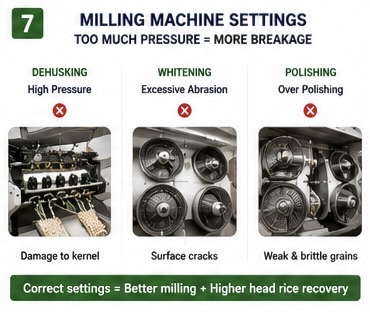
Improper roller pressure or incorrect clearance immediately causes kernel cracking, leading to higher broken rice percentages during whitening.
Step 4: Whitening & Multi-Stage Polishing
After dehusking, the brown bran layer (rich in oils and fiber) is progressively removed in gentle steps to yield translucent white rice.
To prevent friction-induced heat from breaking fragile long grains, export mills employ multi-break vertical abrasive whiteners rather than a single harsh pass.
Brown Rice ➔ 1st Break Whitener ➔ 2nd Break Whitener ➔ Water/Mist Polisher ➔ Rotary SifterDepending on destination specifications:
- Brown Rice: Dehusked with bran intact for health-focused markets.
- Regular White Rice: Milled to standard degree of polish.
- Silky / Mist Polish: A fine atomized water mist polishes the surface, removing loose bran dust and giving grains a glossy, pearl-like shine that extends shelf life.
Step 5: Optical Color Sorting — Where AI Protects Purity
Optical sorting represents the pinnacle of modern grain processing technology.
High-resolution trichromatic RGB cameras, infrared (NIR) sensors, and AI algorithms scan millions of individual grains per minute as they freefall across sorting chutes.
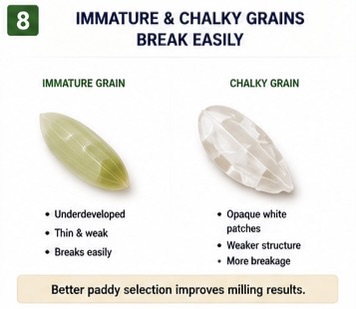
Within milliseconds, high-speed pneumatic ejector nozzles fire micro-bursts of compressed air to blast defective kernels out of the primary stream.
Typical Defects Eliminated by Optical Sorters:
| Defect Type | Appearance / Cause | Why It Must Be Removed |
|---|---|---|
| Chalky Grains | Opaque, milky-white starch structure | Breaks easily during cooking; turns mushy |
| Damaged / Discolored | Brown, red, or dark insect-damaged spots | Ruins visual presentation and commercial grading |
| Immature / Green | Prematurely harvested greenish grains | Uneven cooking and bitter aftertaste |
| Yellow / Fermented | Grains subjected to moisture heating | Indicates microbial spoilage and sour odor |
| Foreign Seed / Grain | Weed seeds, non-basmati contaminants | Violates import purity standards |
Step 6: Laboratory Quality Inspection & Assay
Before any lot proceeds to the packaging line, our quality assurance laboratory draws composite representative samples following ISO and APEDA protocols.
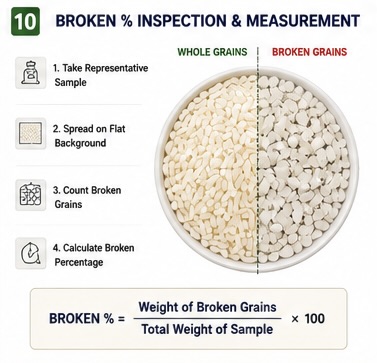
Critical Parameters Tested in Every Export Batch:
- Moisture Content (max 12.5%): Measured by dielectric and halogen moisture analyzers.
- Average Raw Grain Length (AGL): Measured digitally using optical grain image analyzers.
- Elongation Ratio: Tested by boiling standardized samples and measuring cooked length.
- Broken Percentage (e.g., <1%, <2%, <5%): Tested via precision rotary grading cylinders.
- Kett Whiteness Index: Optical reflection measurement for surface whiteness.
- Aroma Assay (for Basmati): Sensory evaluation of 2-acetyl-1-pyrroline volatile compounds.
- Purity / Admixture Percentage: Ensuring varietal purity meets contractual terms.
Understanding Why Rice Grains Break & How We Prevent It
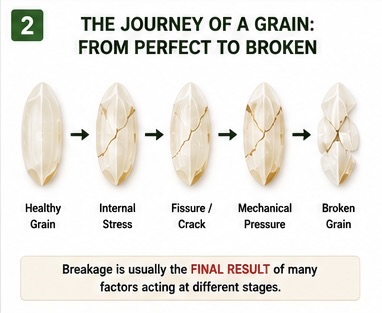
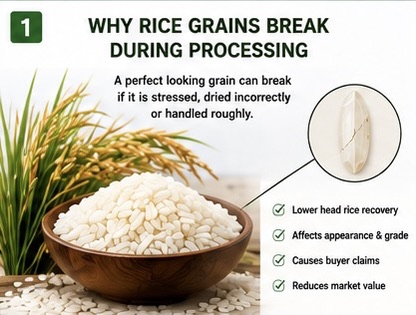
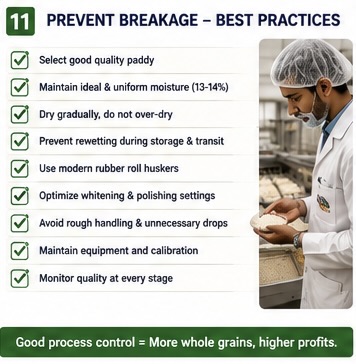
Grain breakage reduces market value and ruins texture. Controlling breakage requires managing physics across every processing step.
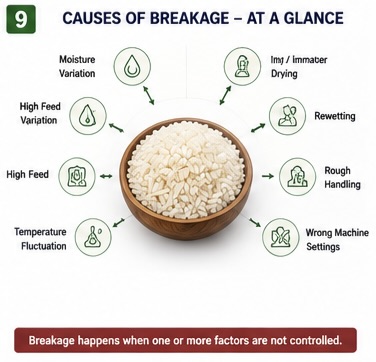
Primary Causes of Grain Breakage:
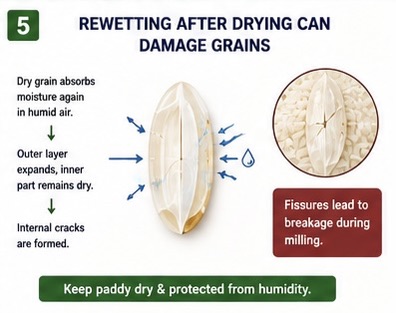
- Thermal & Moisture Shock: Rapid moisture changes create internal fissures. When dry rice absorbs moisture quickly from humid air, tension fractures develop across the grain axis.
- Excessive Milling Friction: Running polishers too fast generates heat that cracks slender grains.
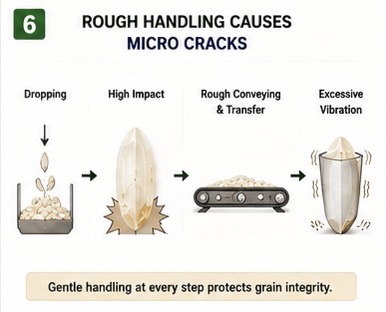
- Mechanical Impact & Rough Handling: High-velocity pneumatic conveying and unpadded drops create micro-fractures that snap during sea transit.
Step 7: Export Packaging — Protecting Quality Across Oceans
Packaging is not just branding; it is an engineered barrier against sea humidity, condensation, pest intrusion, and mechanical compression.
During ocean transit, containers experience drastic temperature swings (from 40°C in equatorial ports to cold destination climates), causing condensation known as “container rain.”
Retail Formats: 1 kg | 2 kg | 5 kg | 10 kg | 20 kg
Bulk Trade Formats: 25 kg | 40 kg | 50 kg | 1,000 kg Jumbo Bags
Packaging Substrates:
- BOPP (Biaxially Oriented Polypropylene) Laminated Bags: Vibrant photographic printing with superior moisture and puncture resistance.
- Non-Woven Fabric & Jute Bags: Traditional breathable choices preferred in Middle Eastern and African markets.
- High-Density Polyethylene (HDPE) / PP Woven Bags: Heavy-duty strength for institutional wholesale.
- Vacuum & Modified Atmosphere (MAP) Packaging: Gas-flushed nitrogen packaging for gourmet and long-storage retail brands.
Step 8: Palletization & Container Stuffing
Loading an ocean container requires structural discipline. Improper stacking leads to collapsed pallets, punctured bags, and cargo shifting during heavy seas.
- Heavy-Duty ISPM-15 Heat-Treated Pallets: Mandatory for customs clearance in Europe, North America, and Australasia.
- Interlocking Stacking Patterns: Distributes weight evenly across lower tiers.
- Stretch Wrapping & Edge Protectors: Secures bags against side-to-side ocean rocking.
- Silica Gel & Calcium Chloride Desiccant Bags: Absorbs ambient container moisture to prevent mold and moisture caking.
- Kraft Paper Container Lining: Complete floor-to-ceiling liner barriers shield bags from condensation dripping off steel container walls.
Step 9: Documentation & Regulatory Compliance
An export consignment is only as fast as its paperwork. Inaccurate documentation creates customs impoundments, demurrage charges, and commercial disputes.
A professional export desk coordinates all mandatory certificates before vessel sailing:
- Bill of Lading (B/L): Clean on-board ocean bill of lading.
- Commercial Invoice & Detailed Packing List: Certified with HS codes and net/gross weights.
- Certificate of Origin (COO): Issued by authorized Chambers of Commerce / Trade Authorities.
- Phytosanitary Certificate: Issued by Government Plant Quarantine Authorities ensuring pest-free cargo.
- Fumigation Certificate: Professional methyl bromide or phosphine treatment verification.
- Independent Inspection Reports: SGS, Bureau Veritas, or Intertek pre-shipment quality and quantity assay.
- Health & Food Safety Certificates: FSSAI compliance, non-GMO declarations, and pesticide residue certificates.
Step 10: The Global Journey — From Port to Plate
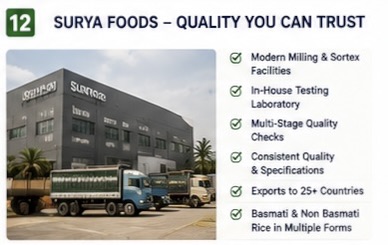
Rice processed at Surya Foods’ state-of-the-art facility in Punjab, India travels via dedicated container freight to gateway ports (Mundra, Kandla, Nhava Sheva) and boards container vessels destined for global commercial hubs:
- Gulf & Middle East: UAE, Saudi Arabia, Qatar, Oman, Kuwait, Bahrain, Iraq, Jordan
- North America: United States, Canada
- Europe & UK: United Kingdom, Germany, Netherlands, Italy, Spain
- Southeast Asia & Oceania: Singapore, Malaysia, Australia, New Zealand
- Africa: South Africa, Kenya, Nigeria, Ghana, Mauritius
Common Sourcing Pitfalls & How to Avoid Them
| Buyer Problem | Root Cause | Surya Foods Prevention Protocol |
|---|---|---|
| High broken percentage upon arrival | Thermal shock or rough transit handling | Controlled aging, slow cooling, and cushioned spiral chutes |
| Pest or weevil infestation | Inadequate pre-shipment fumigation | Multi-day gas-tight phosphine fumigation with post-clearance inspection |
| Damp or caked bags | Container condensation (“container rain”) | Kraft paper lining, container desiccants, and moisture <12.5% |
| Inconsistent cooking / aroma | Grain admixture or unaged stock | Varietal DNA testing, segregated silo storage, and calibrated aging |
| Customs clearance delays | Missing or mismatched document codes | Dedicated trade documentation team with dual-check verification |
Final Thoughts: Building Long-Term Import Partnerships
The journey from a rice mill to a shipping container is not a simple manufacturing line — it is an unbroken chain of quality decisions.
Every decision — from the paddy variety contracted at harvest to the desiccant placed inside the shipping container — directly impacts the meal served in Dubai, London, Toronto, or Singapore.
For international buyers, the most valuable supplier is not simply the one offering the cheapest price per metric ton. It is the partner who guarantees uncompromising batch consistency, bulletproof packaging, and transparent trade communication on every single shipment.
Coming Next in This Series
- How Optical Sorting Works: The Sensors, Cameras, and AI Behind Cleaner Rice
- Rice Grain Defects: The Complete Quality Inspector’s Field Guide
- Why Rice Grains Break During Processing & How to Stop It
- Rice Packaging for Export: Selecting the Right Substrate for Ocean Transit
- Common Rice Export Myths vs. Facts
- The Importer’s Blueprint: How to Audit and Choose a Reliable Indian Rice Mill
Looking for a certified Indian rice export partner for containerized Basmati or Non-Basmati supply? Explore our Global Exports program or contact our export desk directly.