The Buyer’s Guide to Choosing a Reliable Rice Exporter
For importers, distributors, wholesalers, retailers, food-service companies, and private-label brands, choosing a rice exporter is about finding a supplier who can deliver consistently.
For importers, distributors, wholesalers, retailers, food-service companies, and private-label brands, choosing a rice exporter is not simply about finding the lowest quotation. It is about finding a supplier who can deliver the agreed rice, specification, packaging, documentation, and shipment — consistently.
A rice shipment may travel thousands of kilometres before reaching a distributor’s warehouse. Between the mill and the destination, dozens of things can go wrong.
- The grain length may not match the approved sample.
- Broken percentage may be higher than expected.
- Moisture can differ from specification.
- Packaging can fail during transport.
- Documentation errors can delay customs clearance.
- A shipment can miss its vessel.
- Or the first order can be excellent while the next container looks completely different.
For a rice buyer, these are not small quality problems. They can mean:
- Customer complaints
- Delayed supermarket deliveries
- Repacking costs
- Customs complications
- Demurrage and detention
- Price claims
- Lost retail contracts
- Damage to a private-label brand
- Working capital locked inside delayed inventory
That is why selecting a reliable rice exporter is one of the most important sourcing decisions an importer or distributor makes.
India remains one of the world’s most important rice supply origins. During 2025–26, India exported approximately 6.52 million MT of Basmati rice, while major destinations included Saudi Arabia, Iran, Iraq, the UAE, Yemen, and the United States. India also exported approximately 15.01 million MT of non-Basmati rice, with Benin, Bangladesh, Guinea, Togo, and Côte d’Ivoire among the major destinations.
With such a large supplier base, however, buyers need to know how to separate a genuine long-term manufacturing partner from a supplier who can simply offer an attractive price.
This guide explains what to check.
1. Start With the Rice Specification — Not the Price
One of the most common sourcing mistakes is asking:
“What is your best price for Basmati rice?”
before defining exactly what rice is required.
“Basmati rice” is not one standard product. Depending on the market, buyers may require varieties and processing styles such as:
- 1121 Basmati Rice
- 1509 Basmati Rice
- 1718 Basmati Rice
- 1401 Basmati Rice
- Traditional Basmati
- Pusa Basmati
- Raw Rice
- Steam Rice
- White Sella Rice
- Golden Sella Rice
The same issue exists with Non-Basmati Rice varieties such as:
- Sona Masoori
- Sugandha
- Sharbati
- PR 11
- PR 14
- Parmal
A professional supplier should therefore ask questions before quoting. Important specifications may include:
- Rice variety
- Crop year
- Average grain length
- Broken percentage
- Moisture percentage
- Foreign matter
- Damaged/discoloured grains
- Chalky grains
- Milling degree
- Sortex quality
- Cooking characteristics
- Aroma
- Packaging type
- Bag weight
- Pesticide residue requirements
- Destination-country requirements
If two exporters quote dramatically different prices, the first question should not necessarily be: “Why is Supplier B cheaper?”
It should be: “Are Supplier A and Supplier B actually quoting the same specification?”
Real-life buyer pain A distributor approves an attractive-looking sample of extra-long Basmati rice. The commercial shipment arrives. The rice technically has the same variety name, but there is noticeably more broken rice and greater variation in grain length. Retail customers immediately notice that the pack does not look like the sample they approved. The problem wasn’t simply price. It was an inadequately defined specification.
2. Check Whether You Are Dealing With a Manufacturer or Only a Trader
This does not mean that every trader is unreliable. Many trading companies operate professionally. But buyers should understand who actually controls the product.
Ask:
- Does the supplier own or operate the rice mill?
- Where is the rice processed?
- Who performs quality testing?
- Who operates the sortex line?
- Who controls packaging?
- Who is responsible when specifications fail?
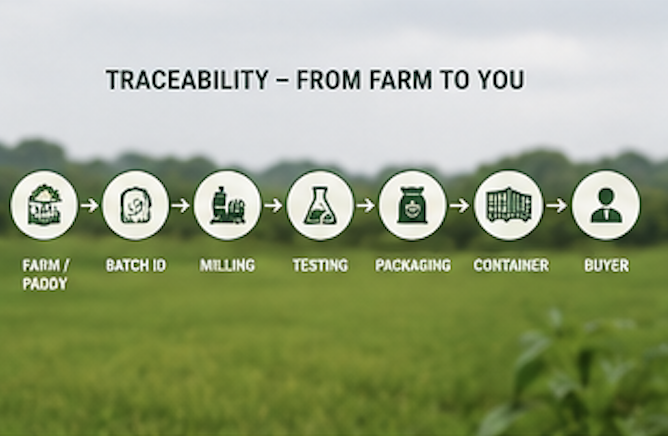
A manufacturer-exporter generally has greater direct control over: Procurement → Milling → Sorting → Testing → Packing → Container Loading
That control can become particularly important when a buyer requires repeated shipments with the same specification.
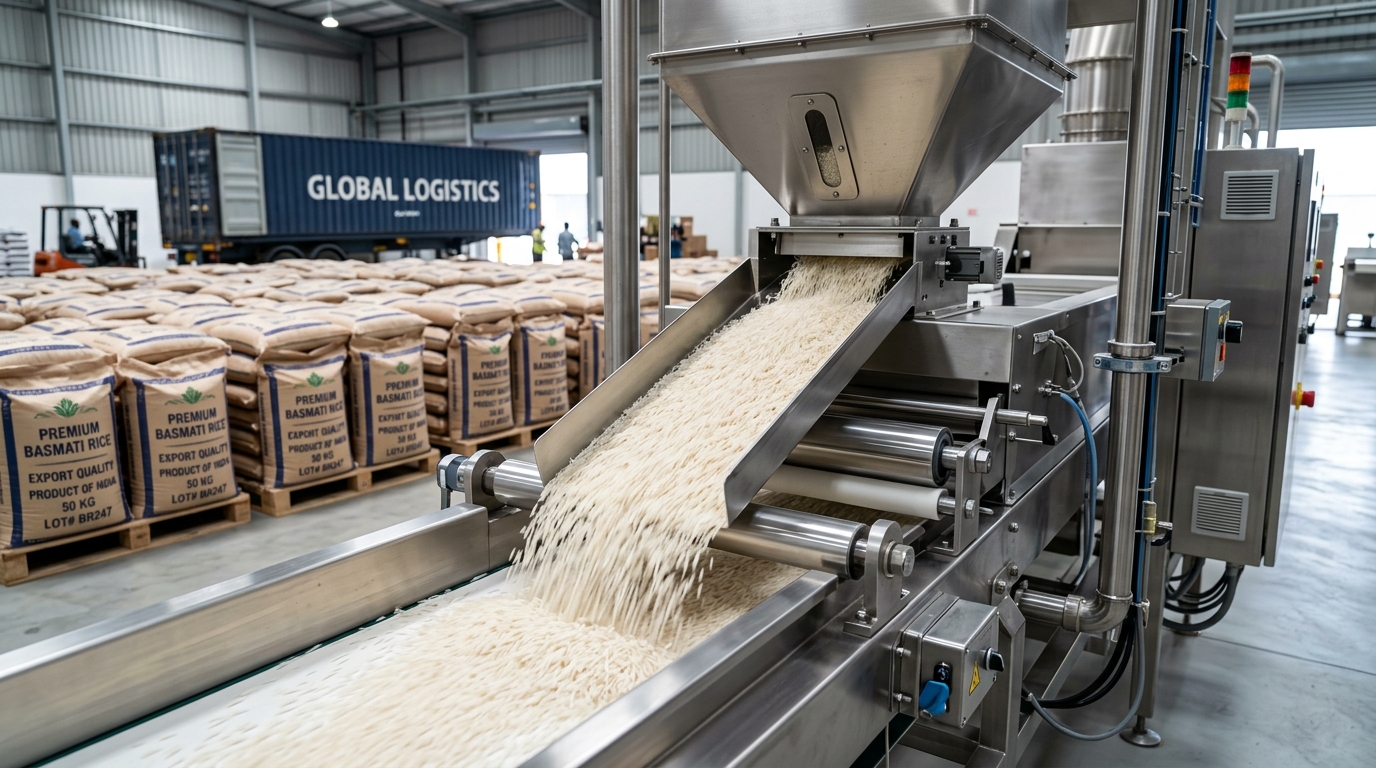
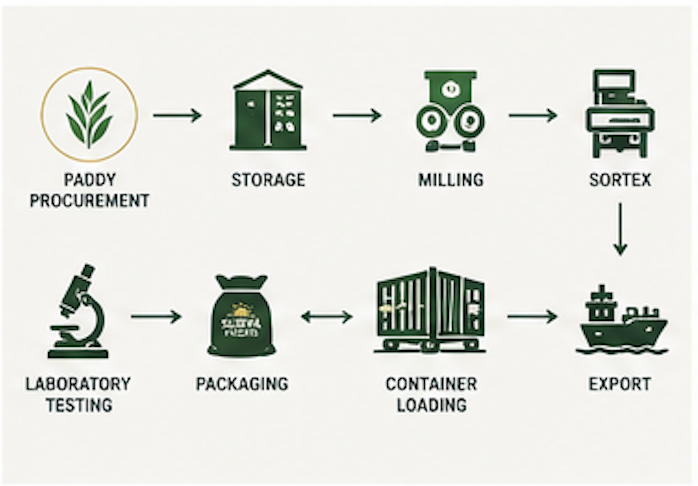 Reliability begins long before the container reaches the port.
3. Ask How the Exporter Maintains Batch-to-Batch Consistency
Getting one excellent container is useful. Getting the same quality across 10, 20, or 50 containers is what builds a dependable supply relationship.
This is where buyers should investigate the exporter’s:
- Paddy procurement system
- Storage practices
- Milling controls
- Sortex capability
- Laboratory testing
- Batch segregation
- Quality inspection
- Packaging controls
The sample trap A beautifully prepared 1 kg sample does not automatically demonstrate an exporter’s ability to supply 500 MT of matching product.
Ask the supplier: “How do you ensure my commercial shipment matches the approved specification?” A serious exporter should have a clear answer.
4. Inspect the Exporter’s Quality-Control System
Modern rice procurement increasingly revolves around Quality Assurance, traceability, food safety, residue compliance, and specification consistency. A reliable exporter should not depend purely on visual inspection.
Depending on the product and destination, testing may involve characteristics such as:
| Quality Parameter | Why Buyers Care |
|---|---|
| Moisture | Storage stability and milling quality |
| Broken % | Grade compliance and visual quality |
| Grain length | Product positioning |
| Foreign matter | Food safety and cleanliness |
| Damaged grains | Overall quality |
| Discoloured grains | Pack appearance |
| Chalkiness | Appearance and cooking quality |
| Milling degree | Finished-rice quality |
| Pesticide residues | Destination-market compliance |
| Cooking characteristics | Consumer experience |
Ask whether the supplier has:
- An in-house laboratory
- Trained QC personnel
- Batch testing
- Pre-dispatch inspection
- Third-party testing capability where required
- Traceability documentation
Why this matters internationally Different destination markets may have different regulatory expectations. Exporting rice to Saudi Arabia, for example, is not necessarily identical to shipping rice to the United States, UAE, United Kingdom, Senegal, or another market. A supplier therefore needs more than good rice. They need export compliance knowledge.
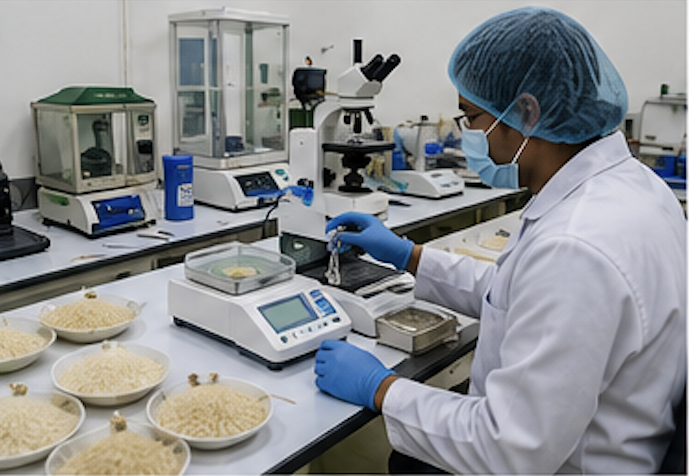 Quality should be measured — not assumed.
5. Look Closely at Certifications
Certificates should never be treated as decorative logos on a website. Buyers should determine which certifications are relevant to their destination, customer, retailer, or food-service channel.
Depending on the transaction, relevant registrations, certifications, and compliance systems may include:
- APEDA
- FSSAI
- ISO 22000
- HACCP
- Destination-specific requirements
- Laboratory testing documentation
- Phytosanitary documentation where applicable
And don’t simply ask: “Are you certified?” Ask: “Can you send me the current certificate?”
Verify: Company name, Facility name, Certification scope, Issue date, Expiry date, and Certification body.
6. Understand the Exporter’s Milling and Sortex Capability
Rice quality does not depend only on the paddy purchased. Processing matters enormously. Modern Rice Milling & Infrastructure can help control broken percentage, degree of milling, uniformity, impurities, and grain appearance.
Optical or Sortex sorting can help detect and remove grains or foreign material that differ in colour or other detectable characteristics. For buyers selling premium rice under their own brand, consistency at this stage is especially important.
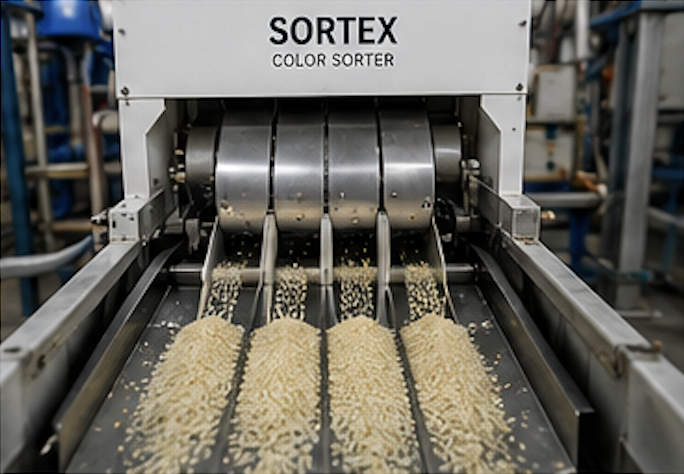 Cleaner rice starts with better detection and sorting.
7. Ask About Pesticide Residue Requirements
For buyers supplying regulated retail markets, pesticide residue compliance can be commercially critical. This is especially relevant when buyers require Pesticide Residue Free Rice programs or have specific maximum residue limits based on destination-market rules.
Do not assume: “Export quality” = “compliant with every country’s residue requirements.” Instead, send the exact requirements before production.
Ask:
- Can the supplier produce PRF rice?
- How is compliant stock segregated?
- Which laboratory performs testing?
- Can test reports be supplied before shipment?
- Can the supplier work according to destination-specific requirements?
8. Evaluate Packaging Capability
A rice exporter may produce excellent rice and still create problems through poor packaging. For distributors and importers, packaging must survive: Factory → Truck → Port → Vessel → Destination Port → Warehouse → Distribution
Ask about:
- PP bags, BOPP bags, Non-woven bags, Jute bags, Pouches
- Consumer packs vs Bulk packs
- Bag strength, Inner liners, Stitching, Printing quality, Barcode requirements
- Palletization where required
9. Private-Label Buyers Need More Than Rice
For private-label distributors, the exporter effectively becomes part of the brand’s supply chain. If you are building a rice brand in Dubai, Riyadh, London, Toronto, New York, Muscat, Doha, Kuwait, or another market, your supplier may need to manage much more than milling.
The project can involve:
- Product selection & Specification development
- Packaging format & Brand artwork
- Print coordination & Bag manufacturing
- Production scheduling & Quality checks
This makes Private Label Rice manufacturing an important capability to investigate.
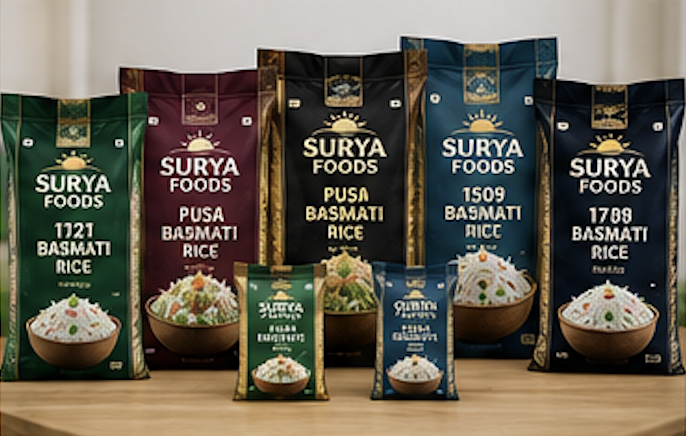 Your Rice Supplier Can Also Be Your Brand Partner.
10. Study the Exporter’s Container-Loading Process
Container loading often receives less attention than milling, but poor loading practices can create expensive problems. Buyers should understand whether exporters inspect containers before loading.
Potential problems include moisture, odour, holes, rust, dirty flooring, previous cargo contamination, weak bags, and improper stacking. The container should be suitable for food shipment before the first bag enters it.
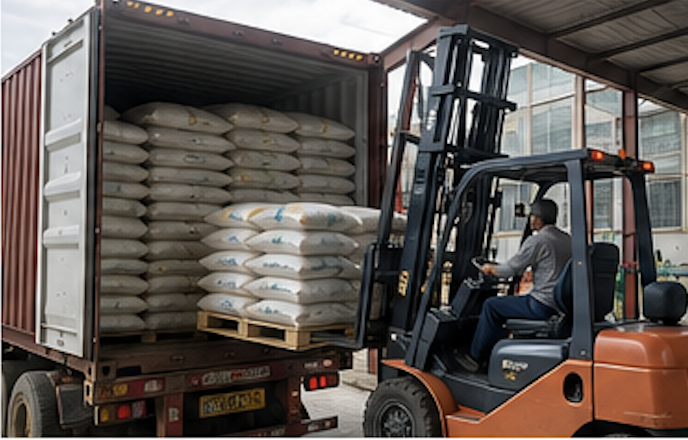 The final quality check doesn’t end at the packing machine.
11. Ask About Documentation Experience
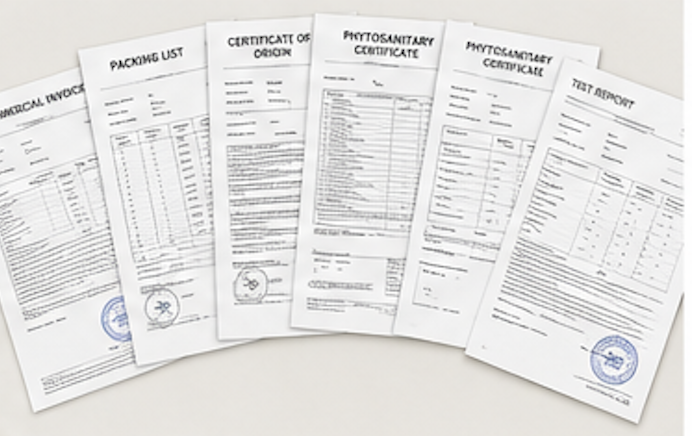
International rice trade depends on documents as much as it depends on rice. Depending on the destination and contract, documentation may include:
- Commercial Invoice & Packing List
- Bill of Lading & Certificate of Origin
- Phytosanitary & Fumigation Certificate
- Inspection & Analysis Certificates
A minor documentation discrepancy can become a major commercial problem, especially with letter-of-credit shipments or strict customs procedures.
12. Don’t Judge an Exporter Only by FOB Price
Rice buying is highly price-sensitive. Price absolutely matters. But buyers should compare total landed risk, not only FOB price. Suppose Exporter A is cheaper by USD 10 per MT. What happens if the shipment arrives with a higher broken percentage, incorrect packaging, short weight, or delayed documentation?
A better sourcing equation is: Competitive Price + Specification Compliance + Consistency + Documentation + Reliability
13. Verify Production Capacity
Importers planning recurring orders should understand whether an exporter can handle their volume. Ask about daily milling capacity, annual processing capability, storage capacity, peak-season lead times, and multiple-container capability.
14. Ask for Evidence, Not Just Promises
Good exporters should be comfortable showing buyers their operation. Useful evidence may include mill videos, current facility photographs, laboratory photographs, sortex videos, packaging videos, and container-loading photographs. For significant contracts, a buyer may also consider a factory inspection or third-party pre-shipment inspection.
15. Evaluate Communication Speed and Transparency
Communication quality often predicts what the relationship will look like when something goes wrong. Observe how the exporter communicates during the enquiry stage. Do they clarify specifications? Do they proactively identify potential problems? The real test of a supplier is not whether complications ever occur, but how professionally those complications are managed.
16. Check Experience With Your Market
An exporter who understands the destination country can often anticipate requirements before they turn into problems. Ask: “Have you exported rice to my country before?” Previous experience does not automatically guarantee performance, but it can significantly reduce the learning curve for both Global Rice Exports and domestic supply.
17. Use a Trial Order Before Scaling
For a new supplier relationship, moving gradually can reduce risk: Sample Approval → Specification Confirmation → Trial Container → Performance Review → Repeat Orders → Long-Term Supply Program
Evaluate the first commercial shipment thoroughly before scaling up.
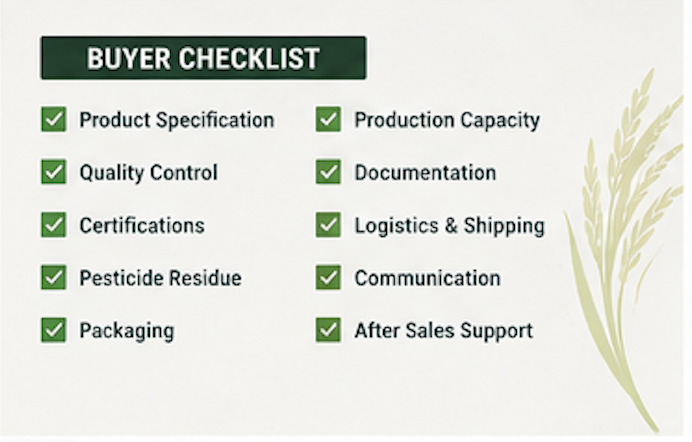
The Rice Importer’s Supplier Checklist
Before confirming your next rice exporter, ask these questions:
Product
- Is the exact rice variety confirmed?
- Is grain length, broken percentage, and moisture specified?
- Are defect tolerances documented?
- Is the approved sample retained?
Supplier
- Does the supplier manufacture/process rice?
- Have you seen the mill?
- Does the facility have modern sorting equipment and laboratory testing?
Compliance
- Are relevant certificates current?
- Are destination-country requirements understood?
- Can pesticide residue testing be arranged where required?
Packaging
- Is bag material approved and pack size confirmed?
- Is private-label artwork and printing checked?
Export
- Are Incoterms clearly agreed?
- Is the production lead time realistic and shipping documents confirmed?
Commercial Reliability
- Can the supplier maintain repeat quality?
- Is communication clear and responsive?
Why Buyers Work With Surya Foods
At Surya Foods, Patran, our objective is not simply to sell rice. It is to help importers, distributors, wholesalers, food businesses, and private-label partners build a dependable rice supply.
Surya Foods describes itself as a manufacturer, processor, and exporter of Indian Basmati rice, with operations dating to 2002. Its current product portfolio includes Basmati varieties such as 1121, 1718, 1509, 1401, Pusa and Traditional Basmati, alongside non-Basmati options including Sugandha, Sharbati, PR 11, PR 14, Parmal and Sona Masoori. The company also offers private-label services and pesticide-residue-free rice options.
Our infrastructure includes modern milling and sortex facilities, quality-control systems and testing capabilities designed to support consistent export supply. Surya Foods currently states that it exports to 25+ countries and holds certifications/registrations including ISO 22000, HACCP, FSSAI and APEDA.
Looking for a Reliable Rice Export Partner in India?
Tell us the rice variety, specification, quantity, packaging, and destination you require. Our team at Surya Foods can help you identify the right product and export solution for your market.
Partner with Surya Foods — From Our Mill in India to Your Market Worldwide.